By practice/PI law firms

Google doesn't remove a law firm's reviews on the merits. It removes them on policy.

Reviewed by Doug Baker, founder · Updated September 24, 2026 · Policy text snapshot August 2026

Illustration: a street with a law office under a green awning. The attorney, in a dark suit, and her intake coordinator, in a beige cardigan, stand in the doorway with empty hands. Six people on the pavement post a one-star review from a phone. Four of the cards are drawn in red and labelled with what can break a Google policy. At the far left, a man in a gray suit in front of a smaller office with a gray awning has the card labelled Competing firm. A man in a slate blue-gray jacket has Client's name and injuries. A young woman carrying a cardboard box of belongings has Former paralegal. Past the doorway, a man in a dark jacket has Threatens to hurt staff. Two cards are drawn in plain gray, the two that don't break a policy. A woman in a beige coat has Turned down at intake, and at the far right an older man in a rust cardigan has Names the attorney.
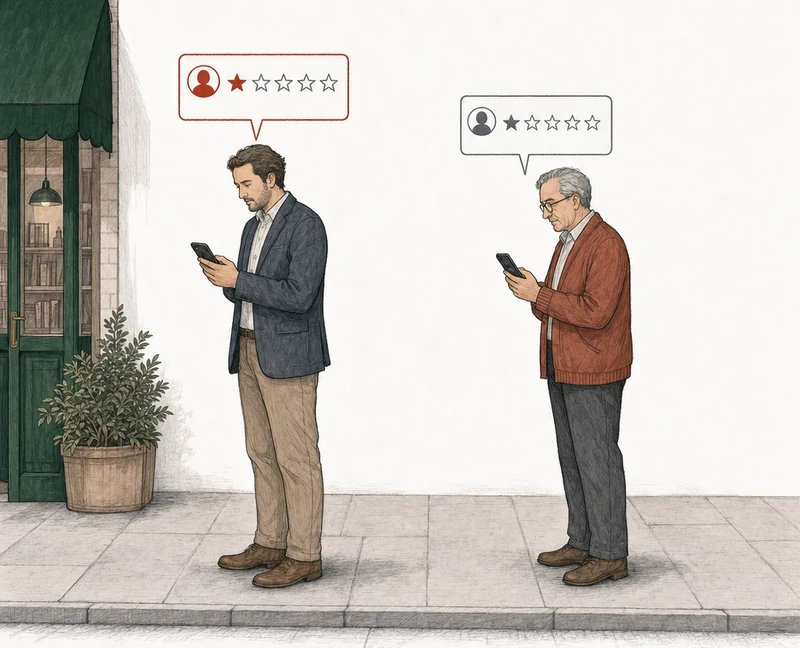
Illustration: two people on the pavement, each posting a one-star review from a phone. At the left, by the law office's green awning, a man in a slate blue-gray jacket has a card drawn in red, labelled Client's name and injuries. At the right, apart from him, an older man in a rust cardigan has a card drawn in plain gray, labelled Names the attorney. Labels: Client's name and injuries, Names the attorney.

The attorney and her intake coordinator, in the doorway, and six one-stars. Four can break a Google policy. The two in gray, a declined intake and a review that names the attorney, don't.

Posting the firm's client's name and injuries can break Google's Personal information policy. Naming the attorney doesn't.

A one-star went up from someone whose case you turned down at intake, or from the other side of a matter you handled. You read it as one-sided, maybe flatly wrong. The reply you'd want to post is the one with the facts of the matter in it, and that's the reply the ethics rules limit. Google won't weigh the facts either. It reads the review against its written policies. A policy is a text, and a personal injury firm already knows how to read one. The question is which clause the review's own words trip, if any. Whether the story is true doesn't come into it.

Have us analyze it

Do any of your firm's reviews break a Google policy?

Put in the firm's name and we'll analyze every bad review on the profile against Google's policies. That means reviews of 2 stars and below with at least ten characters of text. Each one gets a verdict, free. We read only the public reviews, so nothing from your case files or your intake notes comes to us.

No email. No account. The answer is free either way.

Each review comes back with one of three:

Strong grounds for removalPossible grounds for removalNo grounds for removal

The shop owner sits at a table inside the shop after closing, reading her phone. Above the shop floats a row of six review cards: four with five gold stars, two one-star cards drawn in red.

Is it about the merits?

Does Google remove a review because the account of the case is wrong?

No. Google says it doesn't get involved in conflict between businesses and customers, and it asks owners not to report a review just because they disagree with it (Google Business Profile Help). As we read it, a one-sided account of a matter is that kind of disagreement, however wrong it is.

That's harder to hear about the declined intake. They were never your client, so it feels like they have no standing to review you. But Google defines a genuine experience as one at or with the business (Google's glossary). In our read, a phone call or a consultation that ended in a no is an experience with the firm. So "never a client" can be true, and on its own it still isn't grounds. The other side of a matter is no different, as we read it. If the review describes how your firm handled the case against them, that's an experience with the firm too.

We don't prepare an appeal on "never a client" alone. The analysis reads the review's text, not your intake log. What moves a review across the line is what it posts.

Does yours break a policy?

Which Google policies can a review of a law firm break?

Four matter most for a law firm: Personal information, Off-topic, conflict of interest under Rating Manipulation, and Harassment. None of them asks who was right. Three turn on what the review says. Conflict of interest turns on who wrote it. They all sit in Google's content policy. The general question, whether your firm's reviews have grounds for removal, has its own page.

Personal information. A review from the other side of a matter can name your client and describe her injuries. That posts a third party's full name and medical details, and Google's Personal information policy lists both. A review that names your attorney is a different thing. Google allows the name of a professional doing business under that name, and lawyers are on its list. It also allows a name that's part of the business's own name, so the name partners on the sign are covered too. There's more on personal information in Google reviews.

Off-topic. A review has to be based on an experience at or with the business. A one-star that's commentary on personal injury lawyers as a group, with no dealing with your firm in it, falls under Google's off-topic rule.

Conflict of interest. Google's Rating Manipulation policy covers reviews based on a conflict of interest, and it names former employment and industry competitors. A one-star from a paralegal who left last month, or from a firm that competes with yours for the same cases, fits that pattern. The other side of a matter isn't on Google's list, so in our read an opposing party's review isn't a conflict of interest on that fact alone. When we find a conflict of interest, the verdict is possible grounds, never strong. The worked examples are on the conflict-of-interest clause.

Harassment. A review that makes a specific threat of harm against your attorney or someone on staff, the kind that would make a reasonable person fear for their safety, falls under Google's Harassment policy. Anger about how a case ended doesn't reach it. There's more on harassment in Google reviews.

Two similar reviews. One breaks the policy.

Same car accident, same complaint, same one star. One names the firm's client and her surgery. The other names the lawyer. Both are invented.

Breaks the policy

Rick D.
Strong grounds for removal
★★★★sample

This firm came after me over a car accident that wasn't my fault. Their client Sandra Whitfield was walking around fine the week after, and now they're claiming she needs spinal surgery. Disgraceful.

Personal informationClient's name and injuries

The review posts the full name of the firm's client and a claim about her medical care. Google's Personal information policy lists a full name and medical information among the details it covers.

Doesn't break it

Paul S.
No grounds for removal
★★★★sample

This firm came after me over a car accident that wasn't my fault. Their lawyer Dan Kessler twisted every word I said. Disgraceful.

Does not coverNames the attorney

Dan Kessler is a lawyer practicing under his own name, and Google's carve-out allows that. The rest is his own dealing with the firm, and Google counts an experience at or with a business, not only a client's.

The other sections are in the Google review policy reference. The same content policies apply to your reply, too. Google checks an owner's reply against them before it posts, and asks you to edit one it doesn't approve (Google's help page on replying to reviews).

The reply

What can a personal injury lawyer say in a public reply?

Very little about the matter. The ABA Standing Committee on Ethics and Professional Responsibility answered this in Formal Opinion 496, "Responding to Online Criticism," January 13, 2021 (the same PDF, hosted by the Colorado Bar Association). A lawyer who replies can't disclose information relating to a client matter, or anything that could lead someone to confidential information. The opinion suggests a reply as short as this one: "Professional obligations do not allow me to respond as I would wish."

The opinion speaks to the other side of a matter directly. If a review from a former opposing party relates to a real representation, the lawyer still can't disclose anything about it without the client's informed consent. If the poster was never a client or former client, the opinion says the lawyer may respond by saying so. The opinion doesn't say anything about someone you turned down at intake. The opinion also suggests you think about not replying at all, since a reply can draw more attention to the review.

The opinion isn't the last word, and it says so. Its first footnote puts your state's rules above it: "The laws, court rules, regulations, rules of professional conduct, and opinions promulgated in individual jurisdictions are controlling." This page isn't legal advice. What your state's rules require is for your own ethics counsel.

When a reply can say that little, the part you can act on is the policy question.

When there are no grounds

What if none of your firm's reviews break a policy?

Then the firm gets a reply playbook, free. That's where most bad reviews end up, because most of them break no policy at all. A real client's one-star about a slow callback or a settlement they expected to be bigger stays up, however one-sided it reads. About six in ten profiles we analyze have no review with grounds for removal. We say so plainly, with a reply playbook attached. The count sits beside the pilot's counts and their denominators, and we publish how the analysis was measured on the pilot.

The playbook drafts a reply to every review of 2 stars and below on the firm's profile. A review with fewer than ten characters of text gets the draft alone, and every other one also gets its verdict, with a note that we found no policy violation. For a law firm, we write the drafts never to confirm the reviewer was a client and never to mention the matter, even a detail the review itself gives. If the reviewer was never a client and you want to say so, that's your call, not the draft's. You edit the reply and you post it. We don't post anything.

We put the reply last. We settle whether a review has grounds before any reply goes up, in case an early reply works against the appeal.

  1. Verdict

    We settle whether the review has grounds before anything else.

  2. Reply last

    A draft that never confirms the reviewer was a client, for you to edit and post.

The playbook's order for a law firm. Drawn by us, not a screenshot of Google.
No grounds for removal

When there are no grounds, that's the answer. Also free. I'd rather you hear it from us than from Google after the appeal is spent.

When there are grounds

What happens when a review of your firm has grounds for removal?

We prepare the appeal. Someone at the firm files it, from the firm's own Google profile. Google's process runs through the business owner, so we never submit anything to Google, and nobody here logs in as the firm.

Take Rick D.'s review from the pair above. It posts your client's full name and a claim about her surgery, so the argument is Personal information. When you report it, Google asks you to pick a reason, and its help page shows only two examples, Spam and Profanity. Pick the reason closest to Personal information. There's more on choosing the report reason. Google says evaluation typically takes several days.

If Google leaves the review up, you can appeal. Google allows one appeal per review, ever. Our read is that the policy named has to match the argument. So Rick D.'s appeal names Personal information and quotes his own words, the client's name and the surgery. One shot. Filed right. We prepare it, and you file it. There's no second appeal after a denial.

The appeal box is free text with no upload field. Nothing from your client file goes with it, and nothing has to. The appeal argues what the review already posted in public. There's more on the one appeal, argued right. Our part is how the appeal is prepared, and the full sequence is in the Google review removal guide.

  1. Report

    You pick the reason closest to Personal information. Google's only examples are Spam and Profanity.

    Send report
  2. Several days

    Google says evaluation typically takes that long.

    Decision pending
  3. One appeal

    If the review stays up, you get one appeal, ever. It names Personal information and quotes the review's own words.

    Report reviewed - no policy violation
The report, then the one appeal, for Rick D.'s review. Drawn by us, not a screenshot of Google.

Some reviews have possible grounds rather than strong ones, which means the evidence is thinner. Before you pay, we'll tell you that appeals like this sometimes succeed, not usually. A verdict is our reading of Google's written policies, not a forecast of Google's decision.

The appeal fee is $249 for one review or $349 for every review with grounds from that analysis, per Business Profile. The details are in RatingMinder's printed prices. Nothing is behind a call. The review gets removed, or your fee gets refunded. The $349 order covers every review with grounds and has its own rule. If Google removes none of these reviews, the $349 is refunded. The appeal fee only, never subscriptions. The details are in the refund terms.

The rating

If two reviews come down, what happens to a 4.3?

On this sample profile, it becomes a 4.6. The profile has 24 reviews: 13 at five stars, 9 at four, and 2 at one. That's 103 stars, an average of 4.29, which rounds to 4.3. If both one-stars have grounds, you file, and Google removes them, 22 reviews remain with 101 stars. That averages 4.59, which rounds to 4.6. This is arithmetic on a sample, not a forecast for your firm, and only Google decides whether a review comes down. The general case is in how the rating math works.

Check it yourself

Google's wording, unedited

Google's policy text. Source: Google Maps user-contributed content policy, Google's glossary entry for a genuine experience and Report inappropriate reviews on your Business Profile.

Personal information

Content which contains personal information of another posted without their consent such as: full name, or last name, their face in a photograph or a video, or other information which has been reported as having been posted without consent.

The rest of the extract

Personally identifiable information and other personal information about yourself or others including financial information, medical information or personal identification information.

We also allow

An individual’s name if it is part of the commonly known or advertised business entity

An individual’s name if they are a public-facing professional conducting business under their name.

This includes:

Doctors, lawyers, realtors, financial planners, contractors and others professionals doing business under their names

Google, Maps user-generated content policy, Prohibited & restricted content, section Personal information

Off-topic

We don’t allow content which contains general, political, or social commentary or personal rants.

The rest of the extract

Only post content that is based on your experience or questions about experiences at a specific location.

Google, Maps user-generated content policy, Prohibited & restricted content, section Off-topic

Genuine experience

A Genuine or Real Experience is one that reflects a user’s genuine personal experience at or with the place for which they are leaving a review.

Google, Maps user-generated content policy, Glossary, section Genuine experience

Rating Manipulation

Content that is based on a conflict of interest. A conflict of interest may include current or former employment, a contractual or consultory relationship, or other professional or personal affiliations that demonstrate a conflict of interest (such as industry competitors, familial relationships, etc.).

Google, Maps user-generated content policy, Prohibited & restricted content, section Rating Manipulation

Harassment

Content that contains a specific threat of harm against individuals or defined groups of people that would make a reasonable person fear for their mental or physical safety or well being.

The rest of the extract

We don’t allow users to post content to harass other people or businesses, or encourage others to participate in harassment.

Google, Maps user-generated content policy, Prohibited & restricted content, section Harassment

Offensive content

We do allow content that describes negative experiences in a respectful manner.

Google, Maps user-generated content policy, Prohibited & restricted content, section Offensive content

Reporting a review

Do not report a review just because you disagree with it or dislike it. Google doesn’t get involved in conflict between businesses and customers.

The rest of the extract

You can report any review, but only those that violate Google policies are eligible for removal.

Examples: “Spam” or “Profanity”

Review evaluation typically takes several days.

If a flagged review doesn’t qualify for removal, submit a one-time appeal.

Google Business Profile Help, Report inappropriate reviews on your Business Profile

Google's policy and help text captured August 4, 2026. Policy section headings re-checked against the live page September 3, 2026.

Common questions

  • Do you need anything from our case files?

    Not for the analysis. We analyze the public reviews on your Google Business Profile. If an appeal needs a check of your records, you run it yourself, and nothing from them comes to us.

  • A one-star just went up. Should we reply first?

    Find out whether it has grounds first. Opinion 496 suggests you think about not replying at all, and we put the reply last in case an early one works against the appeal. If you want the order laid out, see a bad Google review, step by step.

  • What about Google's process for content that breaks the law?

    That's a separate channel. Google's Legal Removals policy lets users report content they believe violates local law, through its legal troubleshooter. It's a different process from the policy report, and we don't advise on it.

  • Will we know when the next bad review comes in?

    Yes, with Monitoring, which is $39 a month per Business Profile. Monitoring minds the profile for new reviews of 2 stars and below with at least ten characters of text. The alert arrives with the verdict already attached, so nobody at the firm has to keep checking the profile.

RatingMinder