Google review policies/Misinformation and misrepresentation

Misinformation and misrepresentation in a Google review. What Google's policy says.

Reviewed by Doug Baker, founder · Updated September 23, 2026 · Policy text snapshot August 2026

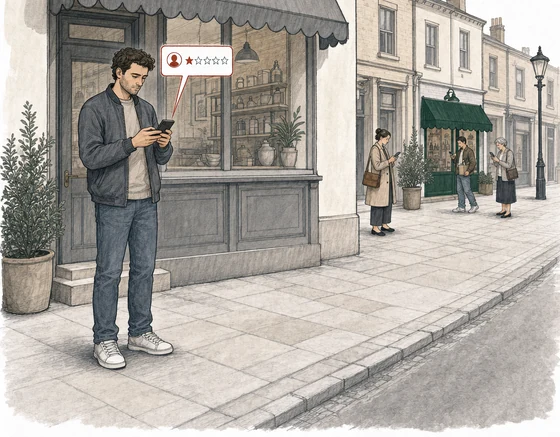
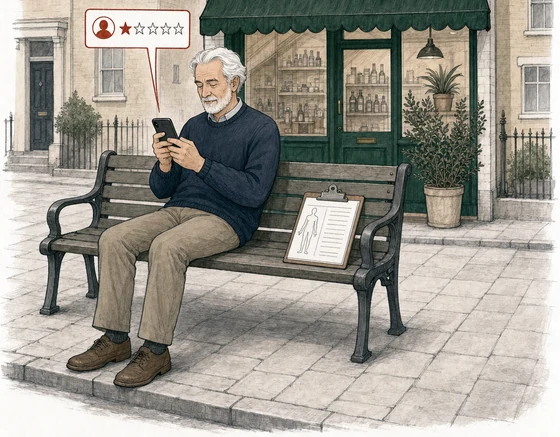
Illustration: a street with a small shop under a green awning, its window lit. Eight people stand on the pavement, each posting a one-star review from a phone. Seven of the review cards are drawn in red and labelled with what the review claims: Health claim, a woman holding up a small medicine bottle; Civic claim, a man beside a small ballot box; Doctored photo, a woman holding a printed photograph with a patch pasted over it; False description, a man in the shop's open doorway; Misleading notice, a woman holding a closed padlock; Scam, a man in a blazer holding out a blank paper slip; Phishing, a young man holding an envelope. At the right, apart, an ordinary customer holding a folded receipt posts a one-star review drawn in plain gray, labelled Customer.
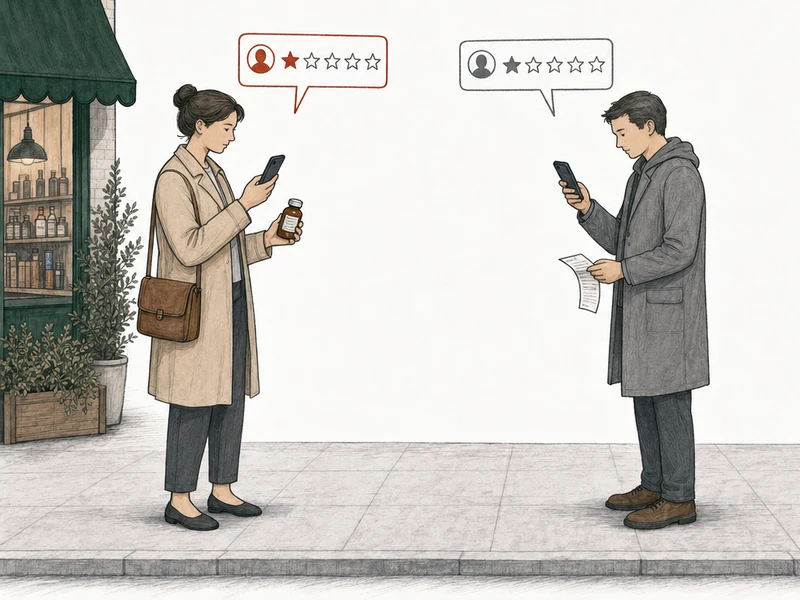
Illustration: two people on the pavement, each posting a one-star review from a phone. At the left, by the green-awning shop, a woman in a plain coat holding up a small medicine bottle; her review card is drawn in red. At the right, apart from her, an ordinary customer holding a folded receipt; his review card is drawn in plain gray. Labels: Health claim, Customer.

These two sections reach the claims in red. Google doesn't settle your dispute with the customer.

These two sections reach the health claim. Google doesn't settle your dispute with the customer.

Google's policy for reviews has two sections named Misinformation and Misrepresentation. In our read, neither one covers a review that you say gets your visit wrong, and both turn on what the review claims and who it could mislead or hurt. Google files them as two separate sections under one heading, Fake & Misleading Content & Behavior. We've put them on one page. The conflict-of-interest line in Misrepresentation has its own page.

Two similar reviews. One breaks the policy.

It's the same dental practice both times, with the same one star and the same annoyed tone. One review makes a health claim and describes no visit. The other describes a visit the owner remembers differently. We made up both of them.

Breaks the policy

Dana K.
Possible grounds for removal
★★★★sample

Parents, read this before you book. The numbing gel they use on kids here causes permanent nerve damage. Every dentist knows it and they use it anyway. Take your children somewhere else.

MisinformationHealth claim

Breaks it, because it states a misleading health claim as fact, describes no visit, and tells parents to act on it. Appeals like this sometimes succeed, not usually.

Doesn't break it

Maya P.
No grounds for removal
★★★★sample

Quoted $180 for the cleaning when I booked. Charged $240 at checkout and told the X-rays were extra. Nobody mentioned that on the phone. Won't be back.

Does not coverCustomer

Doesn't break it. It's a customer's account of a bill, and Google doesn't decide whose memory of the phone call is right.

The policy

Misinformation and misrepresentation in plain terms

Misinformation is about harm. Google means false or deceptive information that can cause significant harm to people, businesses, and society, and it names three forms, all of them harmful content. A misleading health or medical claim. A misleading claim about voting or another civic process. Content about a news event or public debate that someone manipulated to deceive.

Misrepresentation is about using Google Maps to mislead or deceive others. It has five lines. A false or misleading account of a product or service. Facts distorted or left out to scam people. Information distorted or left out in a way that could unduly sway a reader's decision. Content based on a conflict of interest. And content that tricks readers into giving up confidential information, downloading malicious software, or falling for phishing or baiting. In our read, both sections turn on what the review claims and who it could mislead or hurt. Neither one asks Google to decide whose version of a visit is right.

Breaks the policy

  1. A woman in a plain coat outside the shop holds up a small medicine bottle and posts a one-star review.

    Health claim

    Harmful health or medical claims.

    A one-star that tells parents a treatment you use harms children. It's stated as fact and no visit sits behind it.

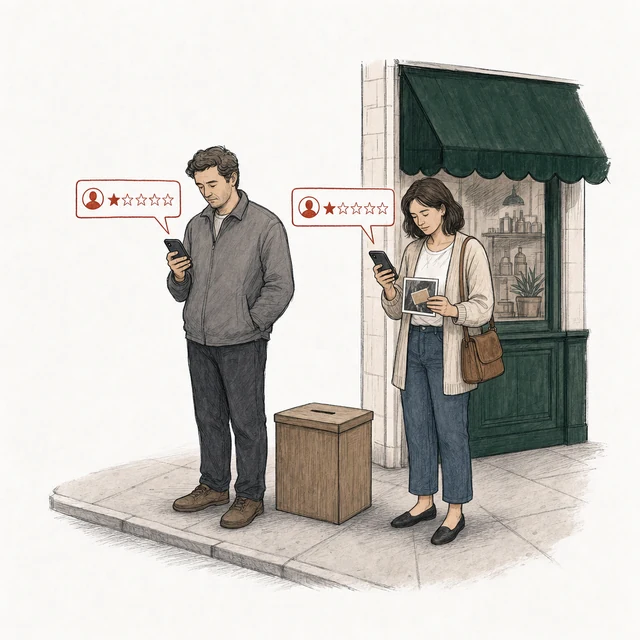
  2. A man beside a small ballot box posts a one-star review; a step away, a woman holding a printed photograph with a patch pasted over it posts one too. The corner of the shop is behind them.

    Civic claimDoctored photo

    Civic claims and doctored news.

    Your shop hosts a polling station, and a review tells voters the station moved across town. Or someone posts a photo of a news event to your profile, doctored to mislead the people who see it.

  3. A man in the open doorway of the shop, its window lit, posts a one-star review; on the pavement a woman holding a closed padlock posts one too. The shop is visibly open behind them.

    False descriptionMisleading notice

    A false account of what you sell, or a misleading notice.

    A review says "closed for good" when your hours show you open. Or it says "no emergencies here" when your listed services include emergency care. In our read this is the narrow end of the section. When a customer says the job went badly, Google doesn't settle whether that account is true.

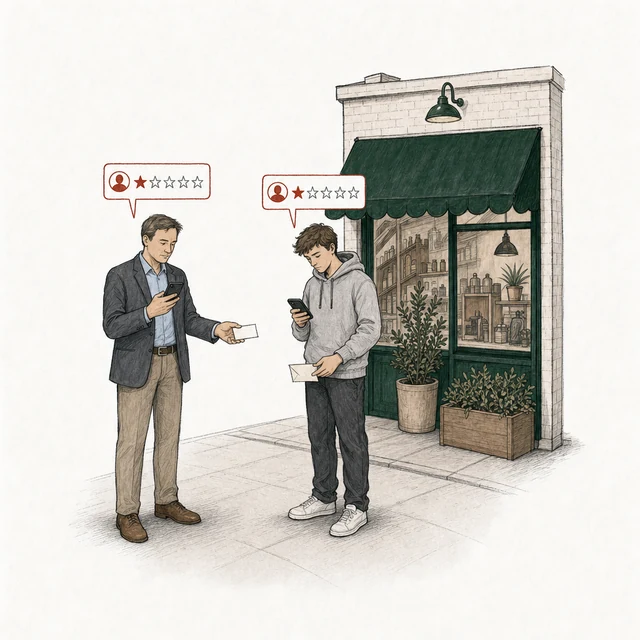
  4. A man in a blazer holding out a blank paper slip posts a one-star review pointing readers to a number that isn't the shop's; beside him a young man holding an envelope posts one too. The corner of the shop is behind them.

    ScamPhishing

    Scams and phishing.

    The review says "for refunds, call this number" or gives a link, and the number isn't yours. Misrepresentation names scams and phishing outright.

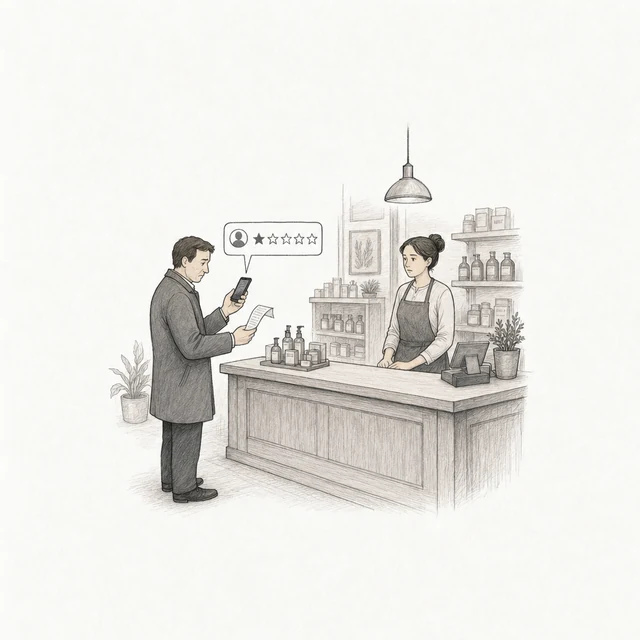
  5. A customer at a shop counter frowns at a folded receipt and posts a one-star review, drawn in plain gray.

    Customer

    Does not cover

    A customer's account of a real visit that you say gets the facts wrong. Google keeps those, even when you're sure the customer is mistaken.

Google's glossary gives each section one line. It defines misinformation as false or inaccurate information that may cause significant harm to people, businesses, or society. It defines misrepresentation as misleading claims or omissions made to gain an improper benefit. So the first is about harm and the second is about someone gaining from a deception. Neither definition mentions a customer who remembers the visit differently than you do.

Google doesn't remove a review because you say it's untrue. It removes reviews that break a policy, and these two sections are among the places where untrue becomes a policy question. Whether any review on your profile reaches that point is the wider question, and whether your review has grounds for removal answers it from the start. One line in Misrepresentation covers content based on a conflict of interest. It's about who wrote the review, not what the review says. That line is Google's conflict-of-interest rule, and it has its own page.

Does yours break it?

What is not misinformation or misrepresentation?

A customer's account of a visit that you say gets the facts wrong. Maybe the technician was on time, or you quoted the price up front. You may be right, and Google still won't settle it. It says so on its reporting page. It tells owners not to report a review only because they disagree with it or don't like it, and it says Google stays out of disputes between a business and its customers.

Owners who ask on the forums hear the same answer. On the Local Search Forum, Stefan Somborac, a Diamond Product Expert at Sterling Sky, tells them not to argue that a review is inaccurate or a lie, because "Google will not mediate a dispute." In a thread on Google's Business Profile forum, the community member Sergio Mohar told a restaurant owner: "Google evaluates reviews against its published policies rather than determining the factual accuracy of customer disputes."

What Google allows

  • Under Misinformation: content that comes from a verifiable, authoritative source.
  • Under Offensive content: content that describes a bad experience respectfully.

So a review that repeats what a health authority says is allowed. A bad visit, described politely, is allowed too.

Four kinds of review look like they belong here but go somewhere else.

Accusations. "Scammers." "They stole from me." These fall under a different section, Offensive content, which names unsupported allegations that a business acted unethically or broke the law. That's where we'd argue a bare accusation. What to do with a review that accuses you of a crime walks through it.

Praise with one star. A glowing review with one star attached is a mis-tap, not misinformation. The fix is a reply asking whether the stars were a slip.

Defamation. Defamation is a legal question, not one of Google's review policies. Google runs a separate route: users can report content they think breaks local law. We're pointing you to Google's channel, not giving legal advice. The FTC's Consumer Review Rule is clear on one point. A groundless legal threat made to get a review taken down is itself a violation.

"It's fake." If your real point is that the writer was never a customer, that's fake engagement's question, not this page's. Start with what to do when the review looks fake.

No grounds for removal

So if a customer tells the visit their way and you disagree, that's a no here, and we'll tell you so. When there are no grounds, that's the answer. Also free.

Google's wording, unedited

Here is Misinformation, in full.

Harmful content that contains deceptive or misleading health or medical information.

The rest of the extract

False, inaccurate, or deceptive information can cause significant harm to individuals, businesses, and society. For that reason, we don’t allow users to post misinformation.

This includes:

  • Harmful content that contains deceptive or misleading information about civic processes.
  • Harmful content of newsworthy events or civil discourse that has been manipulated to deceive or mislead users.

We do allow content from verifiable authoritative sources.

Google, Maps user-generated content policy, Prohibited & restricted content, section Misinformation

Then Misrepresentation, in full. Its conflict-of-interest line is covered on the other page.

False or misleading accounts of the description or quality of a good or service.

The rest of the extract

Misleading information can impact the quality of information on Google Maps. For this reason, we don’t allow individuals to use Google Maps to mislead or deceive others, or make misrepresentations.

This includes:

  • Distorting or omitting facts to scam other users.
  • Distorting or omitting information that could have an undue impact on user decision making.
  • Content that is based on a conflict of interest. A conflict of interest may include current or former employment, a contractual or consultory relationship, or other professional or personal affiliations that demonstrate a conflict of interest.
  • Posting content that tricks users into revealing confidential information, downloading unwanted or malicious software, or subjects them to phishing or baiting.

Google, Maps user-generated content policy, Prohibited & restricted content, section Misrepresentation

Google's policy text captured August 4, 2026. Section headings re-checked against the live page September 3, 2026.

Common questions

  • Can Google remove a review that lies about my business?

    Only if it breaks one of Google's policies, and these two sections are among the places an untrue claim can. Their lines include harmful health or civic claims, news manipulated to deceive, false accounts of what you sell, and scams or phishing. Google doesn't decide whose version of a visit is true. Its reporting page tells owners not to report a review just because they disagree with it.

  • Can I sue over a false Google review?

    We can't answer that. It's a legal question, not a policy one, and Google's review policies don't answer it. Google runs a separate channel where users can report content they believe breaks local law. We can tell you that the channel exists. We can't tell you whether a review is defamatory, and nothing on this page is legal advice.

  • What about a review that calls my business a scam?

    It depends on whether the review describes a visit. In our read, a bare accusation, "scammers" with no visit described, falls under Offensive content's line on unsubstantiated allegations, not these sections. Misrepresentation's scam line covers a review that scams its readers. The same word inside a detailed account of a real visit usually has no grounds for removal.

File it yourself

How do I report a Google review for misinformation?

You report it from your Business Profile. Open Read reviews, select Report next to the review, pick a reason, and send the report.

  1. Open Read reviews

    In your Business Profile, find the review

  2. Select Report, pick a reason

    The pick can limit what the appeal may argue

  3. Send it, then wait

    Typically several days, Google says.

    Decision pending
  4. If it stays up, the appeal

    Report reviewed - no policy violation

    One per review, ever. You file it.

The report, then the appeal. Drawn by us, not a screenshot of Google.

Google gives two example reasons, Spam and Profanity, and it doesn't publish the rest of the menu. We haven't seen a documented reason that names misinformation or misrepresentation. In our read Spam is the closest match for these sections, so that's the reason we'd pick. The page on picking the report reason covers the menu in more detail.

The report is the small step. The appeal is where your argument gets made, and you get the one appeal Google allows: one per review, ever. It names a policy. Name Misinformation or Misrepresentation, whichever line the review trips, using Google's exact wording. Quote that line. Then argue the specific claim and the harm it does to a reader who believes it. Don't argue that the review is unfair. If you name a policy that doesn't match your argument, you can waste the one appeal you have.

Google says a report typically takes several days to evaluate. You file the report from your Business Profile and the appeal from Google's Reviews Management Tool. We never submit anything to Google.

What evidence does a misinformation or misrepresentation appeal need?

Start with the review's own words. Mike Blumenthal, a Diamond Product Expert on Google's Business Profile forum, said it plainly: "Google will not accept external proof from a business owner." In his experience, Google looks only at the review's content and its metadata, not your records. So the evidence in your appeal starts with the review's own words.

What to write out, depending on the line the review trips:

  • The exact sentence that makes the claim, quoted.
  • For a health or civic claim, name the authoritative source the claim contradicts. Google's own carve-out allows content from verifiable authoritative sources, so your argument goes through those sources.
  • For a misleading notice or a false description, write out what your public profile shows, such as your hours or the services you list.
  • For a scam or phishing line, give the number or link in the review, and your real contact details as the profile lists them.
  • The harm to a reader who believes the claim: who would act on it, and what acting on it would cost them.

Before you report.Screenshot the review and the reviewer's profile now, before you report anything.

The limit.Proof that a customer's account is wrong is not what Google weighs. That covers call recordings, camera footage, and your booking system. On a winery owner's thread, Google never treated the owner's camera footage as relevant, and the review stayed up.

The appeal form is free text with no upload field, so everything above goes in as sentences. We don't publish a removal rate for either section. Google decides.

Or have us analyze it

How do you check whether a review breaks these policies?

Type in your business name. We analyze every negative review on the profile against Google's written policies, not just these two sections, because a review can break more than one. We read reviews at 2★ and below that carry at least ten characters of text, and each one comes back with a verdict: strong grounds for removal, possible grounds, or no grounds. Where there are grounds, we prepare the appeal and you file it. If you want the mechanics first, here's how the analysis and the appeal work. Nothing is behind a call.

No email. No account. The answer is free either way.

Each review comes back with one of three:

Strong grounds for removalPossible grounds for removalNo grounds for removal

The shop owner sits at a table inside the shop after closing, reading her phone. Above the shop floats a row of six review cards: four with five gold stars, two one-star cards drawn in red.

Which other Google review policies could apply?

These two sections aren't always the strongest basis for a review. If the writer has a stake in your business, the conflict-of-interest page linked above covers it. If the review describes no real experience at all, the fake engagement policy applies to it directly. If it describes nothing that happened at your location, look at Google's off-topic rule. All the policy categories Google enforces are on one page.

RatingMinder