Special cases/A defamatory review
A defamatory Google review. Google's rules or a lawyer?
Reviewed by Doug Baker, founder · Updated September 23, 2026 · Policy text snapshot August 2026

Google's report doesn't judge whether a review is true, says Mike Blumenthal, a Product Expert in Google's help community. The legal question goes to a lawyer.
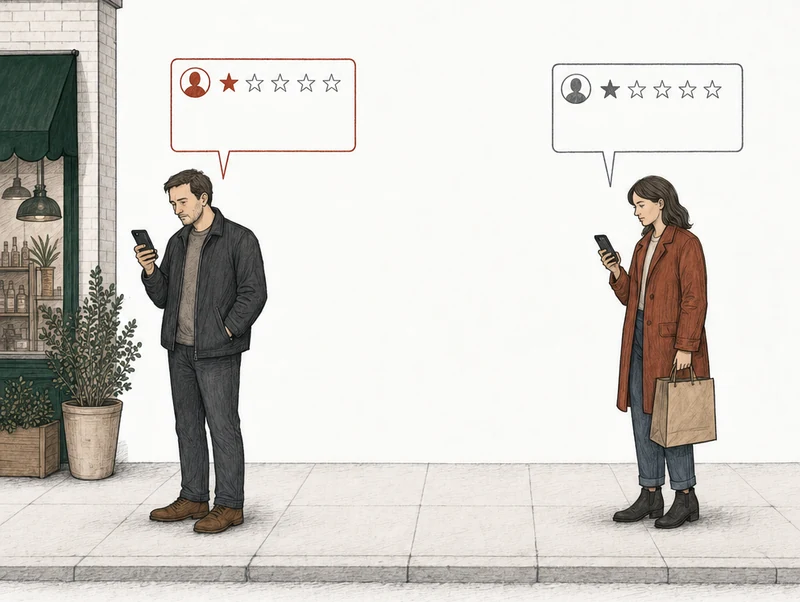
Two reviews. Google's report doesn't judge whether either is true, says Mike Blumenthal, a Product Expert in Google's help community. The legal question goes to a lawyer.
What does Google do with a defamatory review?
Google has two routes for it. Its Maps content policy overview lists defamatory language among the things that break its rules, so the ordinary report from your Business Profile is one route. Separately, Google takes requests about content someone believes breaks local law. That's the legal route, and it's a different process.
Say a review went up claiming something you say never happened. It calls you a scammer, or says someone on your staff stole from a customer. Here's the catch with the policy route. Mike Blumenthal, a Diamond Product Expert in Google's help community, says the report doesn't judge whether a review is true. He wrote in Google's Business Profile community in March 2025 that "Google will not accept external proof from a business owner. They only look at the content and the meta data of the review to determine its eligibility to be removed." Google's help page on reporting reviews even asks owners not to report a review just because they disagree with it.
So proving the review untrue isn't the argument. What the report checks is whether the review breaks a policy Google names.
Two routes
Google's wording, unedited

Here's the sentence from Google's overview that names it.
Deliberately fake content, copied or stolen photos, off-topic reviews, defamatory language, personal attacks, and unnecessary or incorrect content are all in violation of our policy.
The rest of the extract
For example, posts or edits must be based on real experiences and information.
Further, we generally remove full posts (for example, a photo post with a text review attached) even if one part of it is in violation.
Google, Maps User Generated Content Policy Help, section Maps user-generated content policy
Which route?
Which Google policy covers a review that accuses you of a crime?
Offensive content. There's no section called defamation. Google's Offensive content section names unsubstantiated allegations of unethical behavior or criminal wrongdoing, and in the same breath it allows negative experiences told respectfully. The exact wording is quoted on our guide to Google's review policies.
Here's where we draw the line between those two, and it's our read, not Google's. An accusation stated as plain fact, with no visit described, can have grounds. "These people are crooks. Stay away." The same accusation inside a detailed account of a real visit has no grounds. "They charged my card twice, refused the refund, and I'd call that fraud." The second one is a customer describing what happened to them, even if you'd tell it very differently.
A review like this often trips a second rule. A specific threat of harm, a home address, or a call for others to go after someone falls under harassment in Google reviews. A false account of what you sell touches Google's misrepresentation rules, but Google won't referee whose version is right. "Google will not mediate a dispute," as Stefan Somborac put it on the Local Search Forum in December 2025.
And some reviews feel defamatory but are really a different problem. If the writer was never a customer, or the reviews look manufactured, start with removing fake Google reviews. If you think it's a review a competitor posted, or a former employee's Google review, each has its own evidence. If someone wants money to take it down, read Google review extortion, step by step. Google has a separate form for that.
What is Google's legal route for a defamatory review?
A request under local law, made through Google's Legal Help site. Google's Legal Removals page says its content policies apply to Maps everywhere, and that users can also report content they believe breaks local law. It links a form for that. The Legal Help troubleshooter lists Google Maps among its products, but its legal options for a business listing are intellectual property, a court order, and FOSTA-SESTA or the CA Opt Out / CA Safe at Home Program. Defamation isn't one of them. The court-order option there is for content a court has decided is unlawful.
We're not lawyers, and nothing here is legal advice. Whether a review is defamatory under the law where you are is a lawyer's question, and so is what that request asks for and what Google does with it. RatingMinder does no legal work and prepares no legal request. Law firms have written the detailed guides, and both of these send you through a lawyer: Minc Law's guide on Chambers and Partners and MSBA's "A Lawyer's Guide to Removing False Google Reviews" .
Which fits your review, a policy report or a legal request?
It depends on what the review does, not on how untrue it is. A bare accusation with nothing described, a specific threat of harm, a posted address, a writer who was never a customer. Those are policy questions. A detailed account of a real visit you say didn't happen that way is a legal question, for a lawyer.
That review describes an experience, and by Blumenthal's account Google won't weigh your proof against it. So the policy report has nothing to argue, and you shouldn't spend the one appeal on it.
Law firms don't treat the two as either-or. Minc Law's guide lists flagging the review by policy category as a step, and the MSBA guide tells lawyers to flag it by violation category too. Ask your lawyer whether one route affects the other.
File it yourself
How do you report a defamatory review under Google's policy?
Whether you'd call it defamation, slander or libel, Google's report works the same way. Save it, report it, and keep the real argument for the appeal. First, screenshot the review, the reviewer's profile, and the date the review went up. If Google removes the review, its text is gone. Minc Law's guide puts preserving evidence first too.
Save it first
Screenshot the review, the reviewer's profile and the date.
Report it from your profile
Reason: Harassment or bullying, the closest match in our read.
Decision pendingIf it stays up and has grounds, appeal once
Report reviewed - no policy violationArgue Offensive content's allegations clause.
If the question is legal, a lawyer
We do no legal work.
Then open Read reviews on your Business Profile, select Report next to the review, pick a reason, and send it. Google says evaluation typically takes several days. Its help page names only two example reasons, spam and profanity. For an accusation, we pick Harassment or bullying as the closest match. That's our read, and you can check it against which report reason to choose. The flag asks Google to look. It carries no argument.
If the report comes back with no violation found, you get one appeal per review, ever. Our read is that the policy named has to match the argument. For an accusation, the appeal we prepare argues Offensive content's allegations clause, quoted. Name a policy that doesn't match and you can waste the one appeal by presenting the wrong policy argument. Before you spend it, read about the one appeal Google allows. You file it yourself, from your own profile. We never submit anything to Google, legal or otherwise.
Or have us analyze it
Does your review have grounds under Google's policy?
Type in your business name and we'll analyze every bad review on the profile against Google's written policies. Each one gets a verdict, free. We read reviews at 2★ and below with at least ten characters of text, and we see what's on Google: the review, the reviewer's name and review count, the date, and any reply you posted.
That answers the policy question. It doesn't answer the legal one. An accusation with no visit described can get grounds from us. A real visit told in a way you dispute gets no grounds, and we'll say so. When there are no grounds, that's the answer. Also free. Where there are grounds, we prepare the appeal and you file it. Here's how the appeal is prepared.
No email. No account. The answer is free either way.
Each review comes back with one of three:
Strong grounds for removalPossible grounds for removalNo grounds for removal

After you file
What happens after you file, and if Google keeps the review?
The Reviews Management Tool shows the status. Decision pending means Google hasn't looked yet. Report reviewed - no policy violation means it stays up, and that's when you'd use the one appeal, if the review has grounds. Escalated means Google will email you its final decision.
If Google keeps the review after the appeal, the policy route is finished. Reply once, calmly, for whoever reads it next. If you still have a legal question, Google's decision doesn't answer it. That goes to a lawyer.
Our part is narrow. You can see whether the review has grounds first. Where it does, we prepare the appeal and you file it. The review gets removed, or your fee gets refunded. The appeal fee only, never subscriptions. The details are in the appeal guarantee. And if another accusation goes up, Monitoring minds your profile. We check your reviews daily and analyze new negative reviews when we find them, and each alert comes with its verdict attached. For the whole process on any review, here's every step for a bad Google review.
The law around it
What does the FTC rule say about threatening a reviewer with a lawsuit?
Using an unfounded legal threat to try to get a review taken down is a violation of the FTC's Consumer Review Rule. Here's the rule's text, at 16 CFR 465.7(a): "For anyone to use an unfounded or groundless legal threat, a physical threat, intimidation, or a public false accusation in response to a consumer review ... in an attempt to: ... (2) Cause a review or any portion thereof to be removed".
The rule defines "unfounded" at 465.1(p). Whether a threat fits that definition is a lawyer's call.
The part you control is your reply. It's public, and the next customer reads it. Keep it calm and factual, and don't accuse the reviewer of anything.
Common questions
Is a bad review defamation?
That's a legal question, and the answer depends on the law where you are, so a lawyer answers it, not us. Google's report asks something else. Its overview names defamatory language as a violation, and Mike Blumenthal, a Product Expert in Google's help community, says the report doesn't judge whether a review is true.
Can you sue someone over a Google review?
A lawyer answers that. What we can point to is Google's own channel for content someone believes breaks local law, on its Legal Removals page.
Can you sue Google over a review someone else wrote?
Here's the sentence from federal law, 47 U.S.C. §230(c)(1), as printed at Cornell's Legal Information Institute: "No provider or user of an interactive computer service shall be treated as the publisher or speaker of any information provided by another information content provider." What it means for your review is a lawyer's question.
Does RatingMinder handle defamation or legal removals?
No. We analyze reviews against Google's written policies, prepare the appeal where there are grounds, and you file it. We don't prepare legal requests, we don't recommend lawyers by name, and we never submit anything to Google. For the legal route, talk to a lawyer.