Special cases/A competitor wrote it

A competitor's fake Google reviews. What you can prove.

Reviewed by Doug Baker, founder · Updated September 23, 2026 · Policy text snapshot August 2026

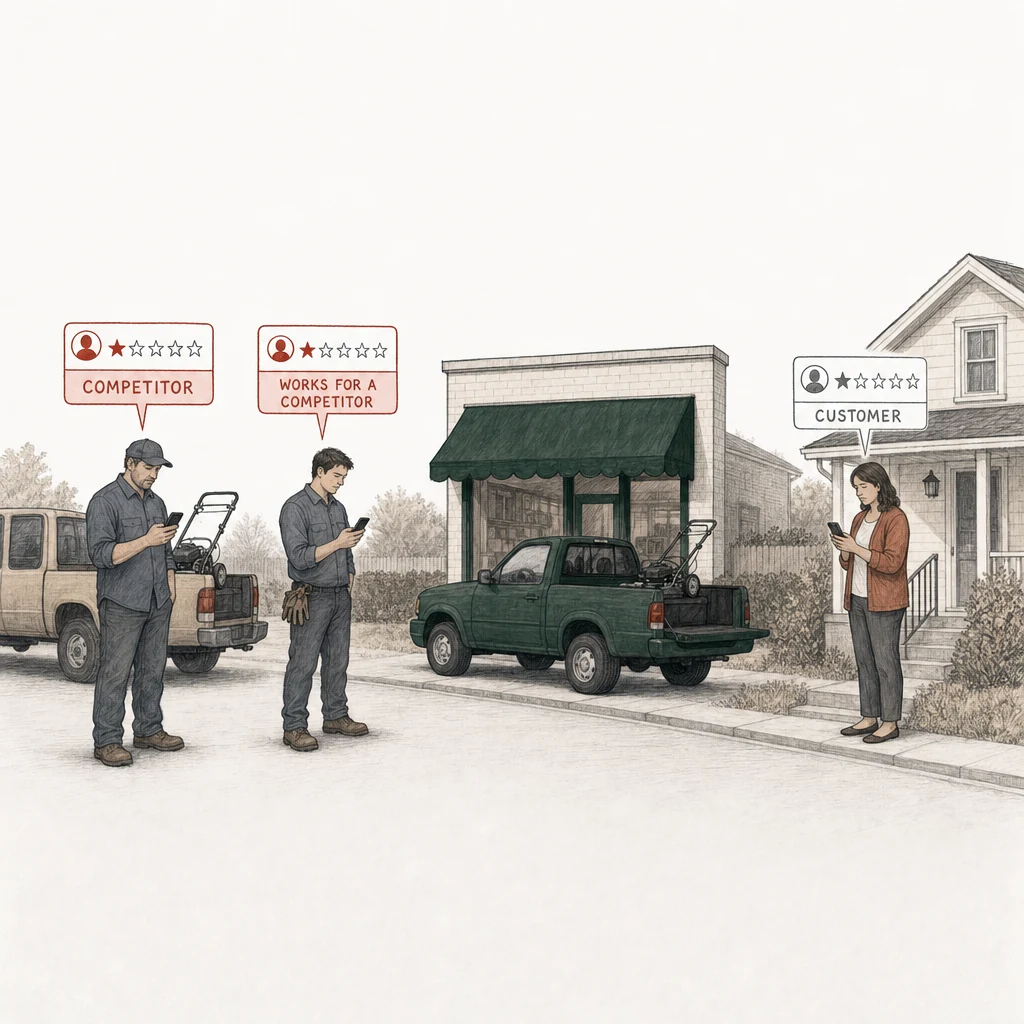
Illustration: a lawn care company under a green awning, its green pickup truck at the curb. Three people, each posting a one-star review from a phone. Two of the review cards are drawn in red and labelled with who the writer is: Competitor, the owner of a rival lawn service standing by his own beige truck; Works for a competitor, one of his crew in the same work shirt. At the right, apart from them, a homeowner outside her house posts a one-star review drawn in plain gray, labelled Customer.
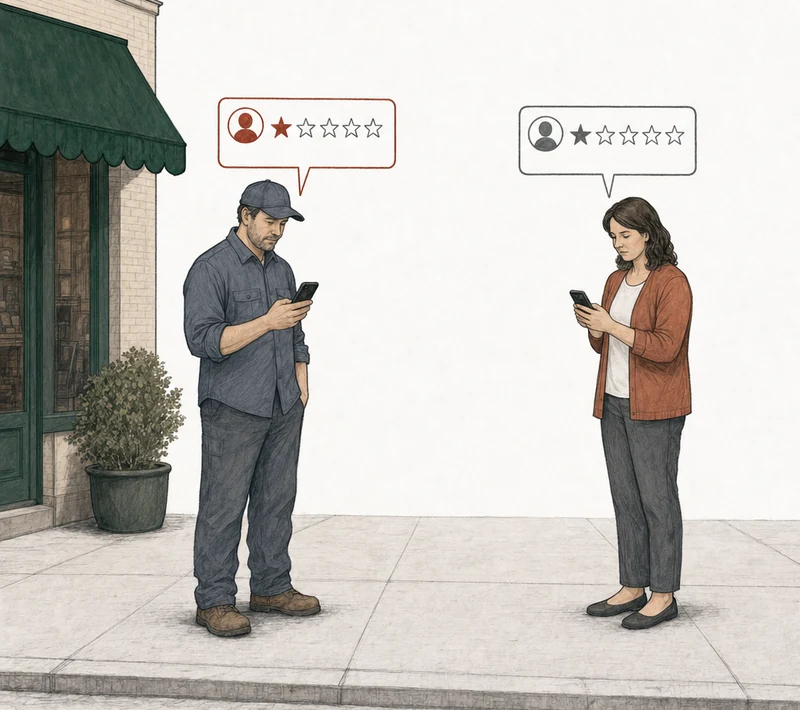
Illustration: two people on the pavement, each posting a one-star review from a phone. At the left, by the green-awning shop, the owner of a rival lawn service in his work shirt and cap; his review card is drawn in red. At the right, apart from him, a customer in a cardigan; her review card is drawn in plain gray. Labels: Competitor, Customer.

In our read, Google's conflict-of-interest rule reaches the rival's owner and his crew. It doesn't reach the customer who switched to them.

Google's conflict-of-interest rule reaches the competitor. It doesn't reach the customer who switched.

When does a competitor's review break Google's policy?

When it comes out of the rivalry and not out of a purchase. Google's conflict-of-interest clause names industry competitors, so a one-star written by someone who runs the business down the road breaks the rule. But Google decides on what it can see, and it can't see what you know. In our read, the tie has to show, either in the review itself or on a public record anyone can check.

You may call it fake, or sabotage, and you may be right. Google doesn't remove a review for being sabotage. It removes it on policy, and this policy turns on who the writer is to you. The clause covers more than rivals, and our page on every relationship the conflict-of-interest clause names walks through each one. There's a second rule that points the same way. Google's Fake Engagement section says nobody may post on a competitor's listing to damage its reputation. If nothing in the review or the public record ties the writer to a rival, in our read this clause doesn't give you an argument. If you're looking at a run of one-stars, that's a different argument, a pattern, and we get to it below.

Does yours break it?

Two similar reviews. One breaks the policy.

Same lawn care company, same one star, same complaint about skipped mowing and nobody calling back. One writer says what he does for a living. Both are invented.

Breaks the policy

Ryan K.
Possible grounds for removal
★★★★2 weeks agosample

I run a lawn service on this side of town, so I know a bad cut when I see one. They skipped two weeks in June, the edges were ragged every time, and nobody called back. Not worth the money.

Rating ManipulationCompetitor

The first sentence says the writer runs a lawn business in the same area. Industry competitors are named in Google's conflict-of-interest clause.

Doesn't break it

Jen M.
No grounds for removal
★★★★3 weeks agosample

Paid for weekly mowing all spring. They skipped two weeks in June, the edges were ragged every time, and nobody called back. I switched to another company and my yard looks better already.

Does not coverCustomer

She paid for the service, and switching to a rival doesn't make her one. Being a competitor is the tie, and mentioning one isn't.

Everything rides on Ryan's first sentence. Take it out and he reads like Jen, one more unhappy customer, and all you'd have left is evidence from outside the review, which Google, by Blumenthal's account below, gives very little weight. So even with that sentence, Ryan gets possible grounds from us, not strong. No review we flag on this clause gets more. Appeals like this sometimes succeed, not usually.

Google's wording, unedited

The clause, as Google prints it under Rating Manipulation.

Content that is based on a conflict of interest. A conflict of interest may include current or former employment, a contractual or consultory relationship, or other professional or personal affiliations that demonstrate a conflict of interest (such as industry competitors, familial relationships, etc.).

The rest of the extract

Contributions to Google Maps should reflect a genuine experience at a place or business. Rating Manipulation includes Incentivized or Biased Reviews, which are not allowed and will be removed from Maps.

This includes:

  • Content that has been posted due to an incentive offered by a business - such as payment, discounts, free goods and/or services.
  • This includes content posted following requests for revision or removal of a review or rating in exchange for an incentive.
  • Content exhibiting unusual volumes or patterns of review contributions that are indicative of efforts to manipulate a place’s rating

Google, Maps user-generated content policy, Prohibited & restricted content, section Rating Manipulation

Misrepresentation repeats the clause without the parenthetical.

Google's policy text captured August 4, 2026. Section headings re-checked against the live page September 3, 2026.

File it yourself

How do you report a competitor's review on Google?

Flag it from your Business Profile, wait for Google's decision, and if it comes back with no violation found, you may be eligible for one appeal, and only one. The flag asks Google to look. The appeal is where you name the policy and say who the writer is.

  1. Save the review and the profile

    Screenshot both before anything changes.

  2. Report it from your profile

    Conflict of interest if your menu shows it, the closest match if it doesn't.

  3. Wait for Google's decision

    The Reviews Management Tool shows the status.

    Decision pending
  4. Appeal once

    Report reviewed - no policy violation

    Name Rating Manipulation and write out who the reviewer is to your business.

The report, then the appeal, for a competitor's review. Drawn by us, not a screenshot of Google.

Nothing about the flag is special to a competitor. Google's steps are the same for any review, and Google says evaluation typically takes several days. The Reviews Management Tool then shows Decision pending until Google looks, and Report reviewed - no policy violation if the review stays up. Escalated - check your email for updates only appears after an appeal.

Google's help page names two example reasons, spam and profanity. In June 2025, Local Search Forum members found a Conflict of interest reason in some accounts and not others. If yours has it, use it. If not, in our read Off-topic is the closest match. You can look over the report reasons Google's menu offers before you pick.

The appeal carries the argument. In our read it names Rating Manipulation, quotes the clause, and then says in plain sentences who the reviewer is to your business. Name a policy that doesn't fit that argument and you can waste the one appeal by presenting the wrong policy argument, so read how to spend the one appeal first. You file it from your own profile. We never submit anything to Google.

Two threads show one more step, a Product Expert escalating the review. In April 2023 a physiotherapy clinic posted a review in Google's Business Profile Help Community. The review promoted a rival practitioner. The clinic said the writer had never been a customer. It came down about five days after a Product Expert escalated it. In October 2025 a marketing agency got "no policy violation" through support for months, then saw the review removed two days after a Product Expert escalated it.
What Google can see

What proves a competitor wrote the review?

The strongest proof is in the review. A line where the writer says he runs a competing business, or a pitch for one. Next is a tie anyone can look up. A suspicion, however strong, is not proof.

Mike Blumenthal, a Diamond Product Expert, wrote in the Business Profile Help Community in March 2025 that Google "will not accept external proof from a business owner" and that "they only look at the content and the meta data of the review." On the Local Search Forum in April 2023, a competitor's one-star named his own company and offered a discount. The flag came back saying the review was fine. The appeal reversed it. That's the kind of review Ryan's sample is modeled on.

A public tie comes second. The reviewer's name and photo match the rival's owner page, staff page, or LinkedIn. Expect a fight with this one. In March 2026 a landscaping contractor in Montana posted that screenshots showed the reviewer owned a competing company in the same market, and that Google had already denied the removal. The agency case above came down only after escalation.

Some things don't count on their own. A display name that looks like a rival's brand. A name that isn't in your customer list. Stefan Somborac, a Diamond Product Expert, put that last one plainly in the Help Community in January 2026: "the reviewer name does not have to match a name you have in your records." If what you really have is a review from someone who was never a customer, that's argued a different way.

What proves it, and what doesn't

  • In the review's text: a line saying the writer runs a competing business, or a pitch for one.
  • A tie anyone can look up: the reviewer's name and photo on the rival's owner page, staff page, or LinkedIn.
  • What doesn't count alone: a lookalike name, no record of the person.

Before you reportSave the review and the reviewer's public profile.

The limitWe don't identify anonymous accounts.

The appeal form is free text with no upload field, so whatever you found gets written out as sentences. Saving comes first because a review can change after you report it. In forum threads, reviewers have edited a review after it was reported and taken out the line that showed who they were. If you can't show who the person is, in our read that's a no.

Or have us analyze it

How do you check whether a competitor's review has grounds?

Put in your business name and we'll analyze every bad review on the profile against Google's written policies. Each review gets a verdict. We look at reviews at 2★ and below with at least ten characters of text, and for each one we read the text, the reviewer's name and review count, the date, and any reply you posted. We don't know who your competitors are, and we don't ask. By Blumenthal's account, Google looks at the review's content and its metadata. Where there are grounds, we prepare the appeal and you file it. Here's what the analysis reads, and what it can't see.

No email. No account. The answer is free either way.

Each review comes back with one of three:

Strong grounds for removalPossible grounds for removalNo grounds for removal

The shop owner sits at a table inside the shop after closing, reading her phone. Above the shop floats a row of six review cards: four with five gold stars, two one-star cards drawn in red.

After you file

Why do competitor reports come back denied?

Because Google reads the review, and a review that doesn't say who wrote it doesn't show the tie. You know who it was. Google can't see it.

The public record is thin, and it isn't kind to this kind of report. The Montana landscaper was denied with those screenshots in hand. In a May 2021 Help Community thread, an air duct cleaning company flagged a review that said "As a prior employee" and recommended two competing companies. It survived three flags. The policy page linked above has more accounts from 2025. That's a handful of forum threads, not a removal rate. We don't publish a removal rate for this category.

So a competitor review never gets strong grounds from us. Possible is the most it gets, and appeals like this sometimes succeed, not usually. The guarantee still covers it. The review gets removed, or your fee gets refunded. The appeal fee only, never subscriptions. The details are in the appeal guarantee and its scope.

No grounds for removal

When there are no grounds, that's the answer. Also free.

Should you reply to a review you think a competitor wrote?

Yes, briefly, once you've decided whether to report it, and without accusing anyone. A reply that treats the writer as a customer ("sorry we let you down") can work against a conflict-of-interest argument later. Practitioners on the Local Search Forum have warned about exactly that.

Saying you can't find them in your records is fine, because it doesn't treat them as a customer. Don't name the rival in public, and don't say they wrote it. You can't prove it in a reply. Keep it to how you run your jobs.

Other situations

What if a competitor is leaving fake reviews in a wave?

A run of one-stars in a short stretch is a pattern. Report the ones in the run that have grounds. Each still gets its own one appeal. Google's Rating Manipulation section covers unusual volumes or patterns of reviews aimed at a rating, apart from the conflict-of-interest clause. A pattern is something Google can see even when no single review shows a tie. Somborac, in the same January 2026 thread, on reviews posted about a day apart: "Google may remove reviews because of some flags in the pattern/behaviour but we don't know what those patterns are." Our guide to a burst of one-star reviews covers the rest.

What if the competitor is buying fake reviews for its own profile?

That's a different problem. Reviews paid for with money or favors fall under Google's rules on paid and fake engagement, and Google lets anyone report a review on any place in Google Maps. It doesn't change the negative reviews on your profile, and our analysis reads only your profile.

If it isn't a competitor, who wrote it?

Sometimes the rival is someone who used to work for you. That's the same clause with evidence you already hold, and it's covered in when a former employee writes the review. Some reviews point at nobody in particular, and those go through fake Google reviews with no competitor behind them. A review that makes false claims of fact may be a legal question, not a Google report, which is when a review may be defamatory. And if you want the full sequence from the start, here are the steps for any bad Google review.

Common questions

  • Is it illegal for a competitor to leave fake reviews?

    The FTC's Consumer Review Rule, 16 CFR 465.2(a), makes it a violation for a business to write a consumer review that materially misrepresents that the reviewer "used or otherwise had experience with the product, service, or business" reviewed. The FTC enforces it. What that means for your situation is a question for a lawyer, and we don't give legal advice.

  • Can Google tell you who wrote the review?

    Nothing in Google's review and Maps content policies says it will. Its policy lets reviewers use pseudonyms, and Blumenthal noted in the Help Community in September 2022 that "Google allows for the use of pseudonyms when leaving a review."

  • Should you post reviews on the competitor's profile in return?

    No. The same Fake Engagement rule that covers their review covers yours. It would also hand them the argument this page gives you.

  • Can a competitor's review come back after Google removes it?

    Yes. In the 2023 physiotherapy case, the reviewer reposted a modified version right away. A repost is a new review, with its own report and its own one appeal. Catching that without checking every day is what Monitoring is for.

RatingMinder