Special cases/They were never a customer

A Google review from someone who was never a customer

Reviewed by Doug Baker, founder · Updated September 23, 2026 · Policy text snapshot August 2026

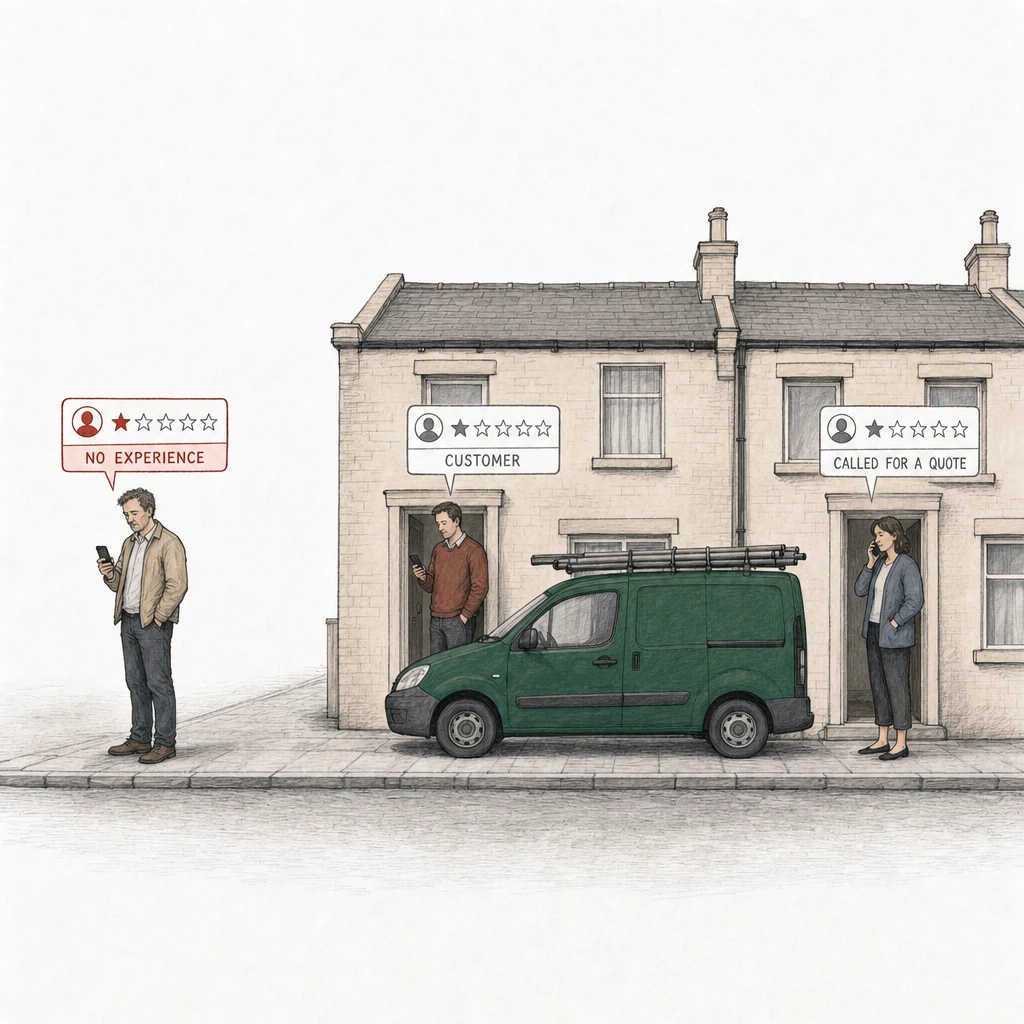
Illustration: a residential street with a plumbing company's green van parked outside a house. Three people, each with a one-star review card above them. At the far left, alone, a man looking at his phone who has never dealt with the company; his card is drawn in red and labelled No experience. At the door of the house with the van, the homeowner, looking at his phone; his card is drawn in plain gray and labelled Customer. At the door of the house next door, a woman on a phone call; her card is drawn in plain gray and labelled Called for a quote.
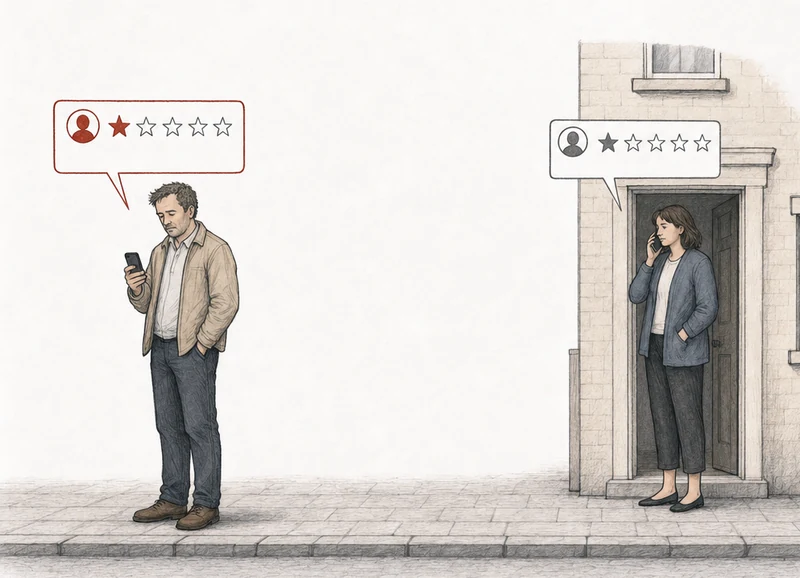
Illustration: two people, each with a one-star review card above them. At the left, alone on the pavement, a man looking at his phone who has never dealt with the company; his card is drawn in red. At the right, apart from him, a woman in the doorway of her house, on a phone call; her card is drawn in plain gray. Labels: No experience, Called for a quote.

Google's Off-topic policy covers the one with no experience of the company. The homeowner had one. So did the woman who called for a quote, because Google counts an experience with a business, not just at it.

Google's Off-topic policy covers the one with no experience of the company. The woman who called for a quote had one, because Google counts an experience with a business, not just at it.

Yes, someone who was never your customer can leave a Google review of your business. You searched your records for the name and came up empty, and that feels like it should settle it. It doesn't. Google's rule doesn't ask whether someone bought from you. It asks whether the review is based on the writer's own experience with your business. A review that describes no experience at all breaks Google's Off-topic policy, and the review's own words are what show it. Your empty search tells you the review probably means what it says. It isn't the violation.

Can someone who was never a customer leave a Google review?

Yes, and a lot of those reviews are allowed. Google's policy glossary defines a genuine experience as one at or with the place being reviewed. That's wider than a sale. A phone call for a quote counts. So does an appointment someone booked and skipped, being turned away at the door, or tagging along with a friend who paid. None of those people show up in your sales records, and every one of them had an experience with you.

What Google's Off-topic policy goes after is a review that isn't based on the writer's own experience at your business. Someone who never dealt with you at all, writing about something they heard or saw. The star count doesn't matter, and neither does how harsh the review reads. And the policy doesn't reach a real customer's harsh account of a real visit, as long as there's no general, political or social commentary or personal rant in it.

Does yours break it?

Two similar reviews. One breaks the policy.

Same plumbing company, same one star, same tone. Neither reviewer is in the owner's records. Kevin says he never called or used the company. Maria describes a call. Both are samples we wrote for this page.

Breaks the policy

Kevin R.
Possible grounds for removal
★★★★sample

Somebody in our neighborhood Facebook group says these guys charged her $900 to clear a kitchen drain and left water all over her floor. I've never called them or used them, and I'm not going to. Stay away.

Off-topicNo experience

He says he never called or used them, and the complaint is someone else's, from a Facebook group. Google asks for the writer's own experience, and his review says there wasn't one.

Doesn't break it

Maria S.
No grounds for removal
★★★★sample

Called for a quote on a new water heater. They said someone would call me back that afternoon. Nobody ever did, so I hired another company. Stay away.

Does not coverCalled for a quote

She never paid them, but she called and was promised a callback. That's an experience with the business, told harshly.

Both names come up empty in the owner's records. So the records couldn't tell these two apart. The words in the reviews did, and the words are what an Off-topic appeal argues from. Kevin's review still gets possible grounds from us, not strong. Appeals like this sometimes succeed, not usually.

Google's wording, unedited

Here's the line that matters, as Google prints it under Off-topic.

Only post content that is based on your experience or questions about experiences at a specific location.

The rest of the extract

We don’t allow content which contains general, political, or social commentary or personal rants.

Google, Maps user-generated content policy, Prohibited & restricted content, section Off-topic

Google's policy text captured August 4, 2026. Section headings re-checked against the live page September 3, 2026.

Google's section has one more sentence. It rules out general, political or social commentary and personal rants. Our page has the off-topic policy, in full.

Why isn't "never a customer" enough on its own?

An appeal that only says "this person was never our customer" asks Google to enforce a rule it doesn't have. The appeal has to show the review isn't based on the writer's own experience. Under Off-topic, that comes from the review's own words, not from your records.

Your search is still worth doing, for your own sake. It can miss real people, though. Google shows whatever display name the reviewer picked, and it doesn't have to match anything on an invoice. The job might sit under a spouse's name, a parent's, an employer's, or a nickname. So search every version of the name you can think of before you call the result empty.

Done that way, an empty result tells you the review probably means what it says. The appeal doesn't lean on it. It leans on the review's words, like Kevin's "I've never called them or used them," and on what actually happened, written down with the date.
What if the review describes a business that isn't yours?

Google's line ends on "at a specific location." A review about a different business, or a branch that isn't yours, isn't based on an experience at your location. For that to count, the review itself has to show the mismatch. When the text names a different business, a location you don't have, or a place you couldn't have served, our analysis can find grounds in its own words. A product you don't sell or a tech name you don't know isn't enough on its own, though it can go into the appeal as evidence. If the review names a business with a name like yours, search Maps for it and say what you find in the appeal. And if the review carries a personal rant, or general, political or social commentary, that's covered too, whoever wrote it. It's the other sentence in Google's Off-topic section.

File it yourself

How do you report a review from someone who was never a customer?

Report it from your Business Profile with Off-topic as the reason, or the closest one if your menu doesn't show it, and save the argument for the appeal. Open Read reviews, select Report next to the review, pick the reason, and send it. Google says evaluation typically takes several days.

  1. Report it

    From Read reviews on your Business Profile. Pick Off-topic, or the closest reason if it isn't there.

  2. Wait for Google

    Google says evaluation typically takes several days.

    Decision pending
  3. Appeal on Off-topic

    Report reviewed - no policy violation

    If no violation is found, the one appeal quotes the review's own words and says what actually happened, with the date.

  4. You file it

    From your own profile. We never submit anything to Google.

The report, then the appeal, for a review from someone who was never a customer. Drawn by us, not a screenshot of Google.

Why Off-topic? Whitespark's guide found an Off-topic option on the menu in October 2024. Google's help page lists only two example reasons, Spam and Profanity, and doesn't publish the rest. If you don't see Off-topic, pick the closest reason. We go through the report reasons, one by one.

The report asks Google to look. The appeal carries the argument. If the report comes back with no violation found, you may be eligible for one appeal. The one we prepare quotes the review's own words and names the policy they break, the one our analysis found. The appeal form is free text with no upload field, so all of it goes in as sentences. Google allows one appeal per review, ever. Our read is that the policy named has to match the argument. Read what the one appeal can carry before you spend it. You file it from your own profile. We never submit anything to Google.

What evidence shows the review describes no experience?

What the appeal leans on

  • The review's own words. Quote the line that says there was no experience, like "I've never called them or used them." The missing experience is the evidence.
  • What actually happened, with the date. A dispute next door, a run-in with one of your vans on the road, something posted online. Write it down so the appeal can name it.
  • The review and the reviewer's profile, screenshotted today, before you report, so you have them whatever happens next.

That's also the limit. The appeal says what the review says and what happened. It doesn't say who wrote the review or why, and nothing here claims to know. If this review is one of several, the wider guide to fake Google reviews covers reading the pattern across them.

Or have us analyze it

How do you check whether a stranger's review has grounds?

Put in your business name and we'll analyze every bad review on your profile against Google's written policies, this one included. We read reviews at 2★ and below with at least ten characters of text, and each one gets a verdict on whether it has grounds for removal. We see what Google shows. The review, the reviewer's name and how many reviews they've posted, the date, and any reply you left. We never see your records, and for a review like Kevin's we don't need them. The verdict rests on the review's own words. Where there are grounds, we prepare the appeal and you file it.

No email. No account. The answer is free either way.

Each review comes back with one of three:

Strong grounds for removalPossible grounds for removalNo grounds for removal

The shop owner sits at a table inside the shop after closing, reading her phone. Above the shop floats a row of six review cards: four with five gold stars, two one-star cards drawn in red.

After you file

What happens if Google leaves the review up?

You'll see it in the Reviews Management Tool. The report sits at Decision pending until Google looks, then reads Report reviewed - no policy violation if Google keeps the review. That's the point where the evidence above goes into your one appeal.

Here's the honest part. Plenty of strangers pass Google's test. The woman who called about a water heater had a genuine experience with that company, and so did the person turned away at your door. When we analyze a review like that, we'll tell you it has no grounds rather than let you spend your one appeal on it.

No grounds for removal

When there are no grounds, that's the answer. Also free.

Where there are grounds, the appeal is $149 for one review. The review gets removed, or your fee gets refunded. Or it's $199 for every review with grounds from that analysis, one fee for the whole set. If Google removes none of these reviews, the $199 is refunded. The appeal fee only, never subscriptions. Our pricing page lists the appeal prices, per Business Profile, and the guarantee page spells out when your fee gets refunded.

How do you reply to a non-customer's Google review?

Reply to a non-customer's review after you've decided on the report and the appeal. Our advice is to skip "sorry about your visit." An apology for a visit concedes there was one, and your appeal is about to say there wasn't. Don't call the reviewer a liar, and don't call the review fake. Say you can't find a record under that name and ask them to get in touch. Something like: "We can't find anyone by that name in our records. If we've missed you, please call us so we can look into it." That's true, it's calm, and it doesn't undercut anything you file.

Other situations

A stranger, a competitor, a former employee, or a wave of one-stars?

Each one is a different argument. Google's rules name competitors outright, and there's a page on when a competitor wrote it. A review from someone who used to work for you is a conflict of interest, argued from your employment records. Several one-stars from strangers in a short window is a volume problem, and a wave of one-stars from strangers has its own page. If all you know is that the name isn't in your records, you're on the right page. For anything else, start with the steps for any bad Google review.

Common questions

  • Can you find out who left a Google review?

    No. Google shows the display name the reviewer chose, and it allows pseudonyms. We don't unmask anyone, and no honest service promises to. You don't need a name for this appeal. It argues from what the review says.

  • What if they left only a star rating?

    You can still report it, since Google lets you report any review. With no text, there's nothing in the review to argue from. Our analysis counts rating-only reviews and gives them no verdict, because there's no text to read.

  • Is it illegal to leave a Google review when you were never a customer?

    That's a legal question, and we don't give legal advice. Going to court is separate from Google's policy process and guarantees nothing about the review. If the review states something false about you as fact, see when a review may be defamatory.

  • What if Google still leaves it up after the appeal?

    Then it stays up, and that's Google's final decision. Google allows one appeal per review, ever, so there isn't a second one to file. What's left is your reply. Say you can't find a record under that name and ask them to get in touch.

RatingMinder