Guides/Google review removal, explained
Google review removal. What Google takes down, and what an owner can file.
Reviewed by Doug Baker, founder · Updated September 23, 2026 · Policy text snapshot August 2026

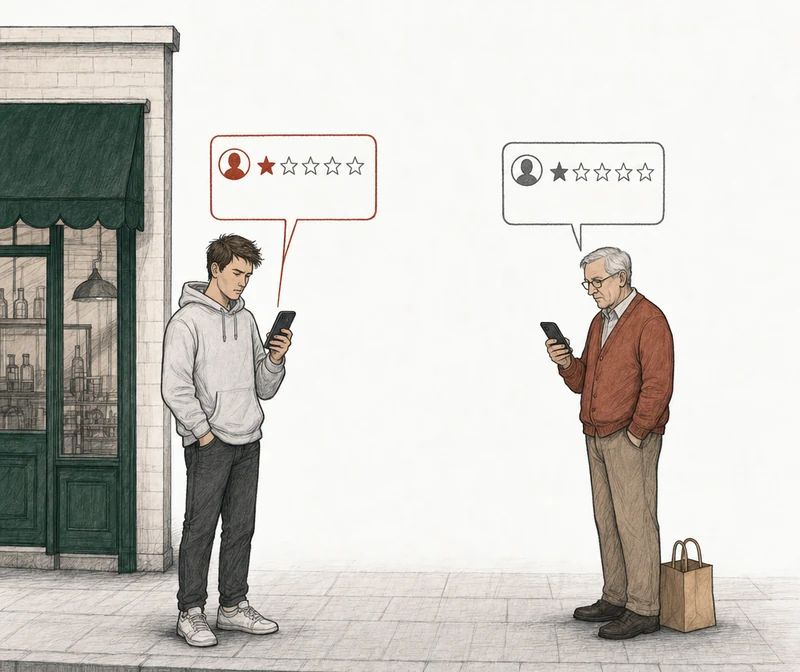
Four of these give Google a reason to take them down. The gray one is a real customer's bad visit, so it stays.
One gives Google a reason to take it down. The other is a real visit, so it stays.
Each red card in the picture is a review Google has a reason to remove. One was written by someone with no real experience of the business. One came from a former employee. One is about some other business entirely. And one arrived with a demand for money to make it go away. The gray card is a customer who had a bad night and said so. That one stays up. Google doesn't remove a review because you want it gone. It removes it on policy.
What is Google review removal?
Google review removal means Google taking a review down because it breaks one of Google's policies. Google makes that call. The business doesn't, and neither does anyone the business hires. Your part is to report the review, and if Google finds no violation, to file one appeal. That's the whole process.

Google puts the first half of it in one line on its help page for owners:
You can report any review, but only those that violate Google policies are eligible for removal.
The rest of the extract
Flagged reviews that violate our content policies are removed and will no longer show on Maps and Search. Learn more about prohibited and restricted content.
Google Business Profile Help, Report inappropriate reviews on your Business Profile
Google's help text captured August 4, 2026.
So anyone can press report, about anything. What a report can't do is take down a review that follows the rules. Here's how the report works, then the appeal, then Google's other channels. Each step links the guide that goes deeper.
Who takes it down
Who can remove a Google review?
Two parties can, Google and the person who wrote it. Google removes reviews that break its policies. Some come down through its automated models, and some after trained reviewers look at them (Google, Maps user-generated content policy). The reviewer can edit or delete their own review (Google, Report or Fix Content). That's the whole list.
The owner isn't on it. Next to a review on your profile you can reply or report. Report is the only one of those that can lead to removal, and after that Google decides. Google's guide for software makers lists five things the connection Google gives businesses and their software can do: list reviews, read one, read several, post a reply and delete a reply. None of the five reports, appeals or deletes a review (Google Business Profile API, Work with review data). So every route to removal that you can start is a form you fill out yourself, on Google's site. We never submit anything to Google, and nobody here logs in as you.
If you want to know whether your review is one Google should take down, find out whether your review can be removed. It's free. Our guide on how to get a Google review taken down follows each route to the end and shows how you'd know it worked. And if you were hoping to switch reviews off altogether, we've looked at whether Google reviews can be turned off.
Does yours qualify?
Which Google reviews qualify for removal?
Only the ones with content that breaks a Google policy. A one-star rating isn't a violation, and neither is a harsh tone or a customer getting the story wrong.
Google says plainly that it won't settle a disagreement:
Do not report a review just because you disagree with it or dislike it.
The rest of the extract
Google doesn’t get involved in conflict between businesses and customers. Negative reviews can highlight areas for improvement and aren’t always a sign of poor service. Learn how to manage customer reviews.
Google Business Profile Help, Report inappropriate reviews on your Business Profile
So the question is never whether the review is fair. It's whether the review contains something Google's rules name. Here's an example of each. One review says your plumber charged too much and the leak came back. That's a real experience, and Google keeps it. Another says your plumber is a thief, with nothing to back it up. Google's offensive content policy has a clause for unsupported accusations of wrongdoing (Google, Prohibited & restricted content), so that review can have grounds for removal.
The complaints that do qualify tend to land in a few places. A review with no real experience behind it. One posted by a competitor, a relative or a former employee. One that threatens someone, prints someone's private details, or describes a different business. Google's review policies, category by category covers each one with a pair of examples like the one above. Two come up often enough to have their own pages. Off-topic Google reviews covers the review about something that never happened at your business. An ex-employee's Google review covers the review from someone who used to work for you, because Google's policy counts former employment as a conflict of interest (Google, Prohibited & restricted content).
File it yourself
How do you report a Google review for removal?
From your Business Profile. You open your reviews, select Report next to the one you mean, choose a reason and send it. Google's Reviews Management Tool does the same job from a different screen, and it's also where you check on a report later (Google Business Profile Help). Both routes are covered screen by screen in how to report a Google review. If the review showed up this morning and you want everything in order, start with how to remove a bad Google review.
The reason you pick matters more than it looks. Google shows it as a menu, and the only options it publishes are two examples, Spam and Profanity. It doesn't publish the full list, and menus differ from account to account. On the Local Search Forum, a December 2024 screenshot showed a conflict-of-interest option in the menu. In June 2025, moderators there found it in some accounts and not in others (Local Search Forum). If your reason isn't on the menu, pick the closest match.
Here's why the reason matters. It's the start of the argument your appeal will make later. The appeal names a policy, and if that policy doesn't match the argument, a mismatch can waste the one appeal you get. So pick the rule the review actually breaks, not the one that sounds worst. The report itself has no box where you can explain anything. Sterling Sky's guide, dated January 9, 2025, says that's why a review you report as a violation often stays up (Sterling Sky). You can't give Google any context.
What happens after you report a Google review?
It goes into a queue. Google says evaluation usually takes several days, and the Reviews Management Tool shows the status. If the status comes back as no policy violation, the appeal opens. You get one per review, ever. You can appeal up to 10 reviews at a time, and Google emails you the result (Google Business Profile Help). The appeal form is free text with no way to attach anything, so the argument has to stand on its words.
You report the review
Report a new review for removalIn the Reviews Management Tool, or with Report on your Business Profile. You pick a reason from Google's menu.
Google hasn't looked yet
Decision pendingThe report is in the queue. Google says evaluation usually takes several days.
Google found no violation
Report reviewed - no policy violationThe report didn't work. This is where the one appeal opens.
You file the one appeal
Submit an appealUp to 10 reviews at a time, on a free-text form with no upload.
The answer comes by email
Escalated - check your email for updatesIf the review breaks a policy, Google removes it. If it doesn't, it stays, and there is no second appeal.
You can't take the last step twice. For a policy violation, that appeal is the only one Google gives the review, so the argument has to be right before you send it. Our guide to the one-time Google review appeal covers what goes in the form and why appeals get denied. If someone told you to "dispute" the review, how to dispute a Google review explains what that means when Google has no dispute button.
How long does a review removal decision take?
Several days for the report, by Google's own estimate. That's the only timing Google publishes. It gives no timeline for the appeal, the extortion form or the legal route. Real reports can take much longer. In a July 2025 Local Search Forum thread, an owner said a report had sat at Decision pending for almost two months. A lot of the pages ranking for this search print a removal window. Google doesn't, so we won't make one up.
Other ways a review comes down
What removes a Google review without a report?
Mostly Google's own systems. Google's automated spam detection removes reviews that nobody reported. Google also says the system occasionally removes a legitimate review by mistake, and tells owners to contact support when that happens (Google Business Profile Help). Google's machine-learning models scan what people post for signs of suspicious activity (Google, Maps user-generated content policy). Reviews with no genuine experience behind them fall under Google's Fake Engagement policy, and our page on fake engagement in Google reviews explains what it covers.
A removal isn't necessarily final, and Google's own pages disagree on this. One says Google can reinstate or take down content no matter how your report turned out (Google, Report or Fix Content). Another says a review removed for breaking a policy stays removed (Google Business Profile Help, About missing or delayed reviews). Google hasn't explained how the two fit together, so we won't guess. If one of your reviews disappeared and nobody reported it, why Google reviews disappear goes through the usual causes.
When does a review go through a different Google channel?
In two cases: when someone wants something from you in exchange for taking reviews down, and when you believe a review breaks the law, not just a policy. Google runs a separate form for review extortion, meaning bad reviews tied to a demand for money or favors to remove them.
The form's scope is narrow:
This reporting channel and the need for evidence of extortion are exclusively for cases where you‘ve been directly subjected to an extortion attempt demanding money or favors in exchange for review removal.
Google Business Profile Help, Report negative review extortion scams on your Business Profile, section Understand what happens after you submit the report
So the form is for a demand made to you, and Google wants proof of it, such as screenshots of the messages. You file it yourself. Our guide to Google's merchant extortion form covers what to save first. A burst of bad reviews with no demand attached isn't extortion. It goes through the ordinary report, and how to remove fake Google reviews covers the evidence that report needs.
There's also a legal route. Google's Maps content policy says a review you believe breaks the law can be reported, not only one that breaks a policy (Google, Maps user-generated content policy). Google's legal help pages cover Google Maps content, and a court order is one of the grounds they name for it. When content breaks Google's policies, Google typically removes or restricts it everywhere. A legal removal usually applies only in the country where the content is unlawful. You can file the same review through both routes, separately (Google Legal Help, Report content on Google). That describes Google's form. It isn't legal advice, and for advice you'd talk to a lawyer.
When there are no grounds
What if the review doesn't break a Google policy?
Then it stays up. You can't change that, we can't, and a paid service can't either. You can still report it, but if you then appeal, you've used the only appeal that review will ever get on an argument Google has already said it won't hear.
What's left is still worth doing. Fix whatever in the review was true. Reply in public, calmly, for the people who read it later. How to respond to a bad Google review walks through writing that reply. The reviewer can still delete the review, but that's their decision alone. Don't offer them anything for it. Google's policy bars a business from offering payment, discounts or free goods to get a negative review changed or removed (Google, Prohibited & restricted content). If what you really care about is the number, how to improve your Google rating shows the arithmetic of the average.
Most bad reviews we analyze have no grounds, and we tell you so with a reply playbook attached. When there are no grounds, that's the answer. Also free.
Paying for help
What can a review removal service actually do?
Less than the ads suggest. A service can read the review against Google's policies, gather the evidence, pick the policy the appeal should argue, and write the appeal. That's real work. What no service can do is decide the outcome, because only Google decides, so no service can promise one either.
Firms that offer to remove Google reviews sell different things. Some print a success rate. Some sell a no-win, no-fee deal. Nobody can honestly sell "guaranteed removal." Google doesn't guarantee a removal to anyone, so anyone selling one is selling something else. Google review removal services, compared lays out what those firms publish about price and method. If you're looking at software instead, what each kind of review removal tool does covers that, including who actually presses submit.
What a service can and can't do
- Can read the review against Google's policies. This is the step that tells you whether filing is worth it at all.
- Can save the evidence. The review, the reviewer's profile and the dates, before any of them change.
- Can pick the policy and write the argument. The appeal names a policy and argues it. In our read, the reason you report under should be that same policy.
- Can't decide the outcome. Only Google decides.
- Can't promise a removal. Nobody outside Google can.
Here are our prices. The analysis is free. If a review has grounds, we prepare the appeal for $149, or $199 for every review with grounds from that analysis. Monitoring is $39 a month. Every price is per Business Profile, not per account, and all of it is on appeal pricing per Business Profile. Nothing is behind a call. The review gets removed, or your fee gets refunded. The appeal fee only, never subscriptions. The full terms are in appeal guarantee terms. What we hand you, and what you file yourself, is in how RatingMinder prepares an appeal.
Common questions about Google review removal
Can a business owner delete a Google review?
No. Next to a customer's review you can reply or report, and only Report can lead to removal. Google decides what happens after that. The person who wrote the review can edit or delete it. You can't, and neither can anyone you hire.
Can anyone guarantee a Google review removal?
No. Google makes the call, and it only removes reviews that break a policy. Nobody outside Google controls that decision, so a promise of removal is a promise about someone else's decision. What we guarantee is the appeal fee.
Can I get a true negative review removed?
Only if something in it breaks a policy. A true review can still include a private phone number or a threat, and that part can give it grounds. The bad experience itself never does.
How much does Google review removal cost?
None of Google's published steps for reporting or appealing asks you to pay. A firm charges for its work, often only after a removal. Our analysis is free, and where a review has grounds we prepare the appeal for $149, or $199 for every review with grounds from that analysis.
Or have us analyze it
How do you find out whether your reviews qualify?
Put in your business name and we'll analyze every bad review on the profile against Google's written policies, not just one category. That means every review of 2★ and below with at least ten characters of text. Each one gets a verdict: strong, possible or no grounds for removal. Possible grounds means the evidence is thinner. Appeals like that sometimes succeed, not usually, and we tell you so before you pay. About six in ten profiles we analyze have no review with grounds for removal. We say so plainly, with a reply playbook attached. You can see how the verdicts are measured and the counts in published RatingMinder numbers. If you'd rather not come back and do this again, with Monitoring we check your reviews daily and analyze new negative reviews when we find them.
No email. No account. The answer is free either way.
Each review comes back with one of three:
Strong grounds for removalPossible grounds for removalNo grounds for removal

Which guide answers your question?
Open the guide for what happened to you. Each one takes a single step and goes all the way through it. If you have a bad review in front of you today, start with the guide to removing a bad review. If you already reported it and Google said no, open the appeal guide. If a review came with a demand for money, go straight to the extortion guide. And if it came from someone who used to work for you, the former-employee guide lists the evidence that argument needs.
Can it be removed?
- Can this Google review be removed?the free analysis that reads your reviews one at a time for grounds.
- Remove a bad Google reviewwhat to do, in order, the day a bad review lands, including when there are no grounds.
- Get a review taken downwho can actually take a review down, and how you would know it worked.
- Remove fake Google reviewsthe four policies a review an owner calls fake usually trips, and the evidence each needs.
- Improve your Google ratingthe arithmetic of the average, and the reviews Google removes.
- Respond to a bad Google reviewwhen a review has no grounds for removal, the public reply is what you have, and how to write it.
- Google review removal toolswhat each kind of tool does, who presses submit, and the free analysis.
Report and appeal
- Report a Google reviewwhich reason to pick at the report step, and why it should match what your one appeal will argue.
- Dispute a Google reviewGoogle has no dispute button, so this is the report, the statuses, and the one appeal.
- The one appealhow to file the one appeal a review gets, why appeals get denied, and what is left after a denial.
Special cases
- A former employee wrote ita review from a former employee, which Google's policy says can be a conflict of interest, and the evidence that argument needs.
- Review extortionGoogle runs a dedicated merchant extortion form; what to capture first, and what happens after you file.
- Reviews not showing upa review that disappeared is usually a removal, sometimes a policy check still running or a profile with reviews disabled, and this sorts out which.
- Turning reviews offwhether an owner can turn Google reviews off, and what is available instead.
- A competitor wrote ita review from a competitor, which Google's policy calls a conflict of interest, and the evidence that argument needs.
- They were never a customera review from someone with no record of a visit, and when Google reads it as fake engagement.
- Review bombinga sudden run of one-star reviews, what Google does about it, and which form to file when a demand comes with it.
- A defamatory reviewa review that accuses you of something, the two ways Google lets you report it, which of those reviews a policy report covers, and what stays a lawyer's question.