Guides/Respond to a bad Google review
How to respond to a bad Google review. What to say when it breaks no policy, and what to leave out.
Reviewed by Doug Baker, founder · Updated September 23, 2026 · Policy text snapshot August 2026

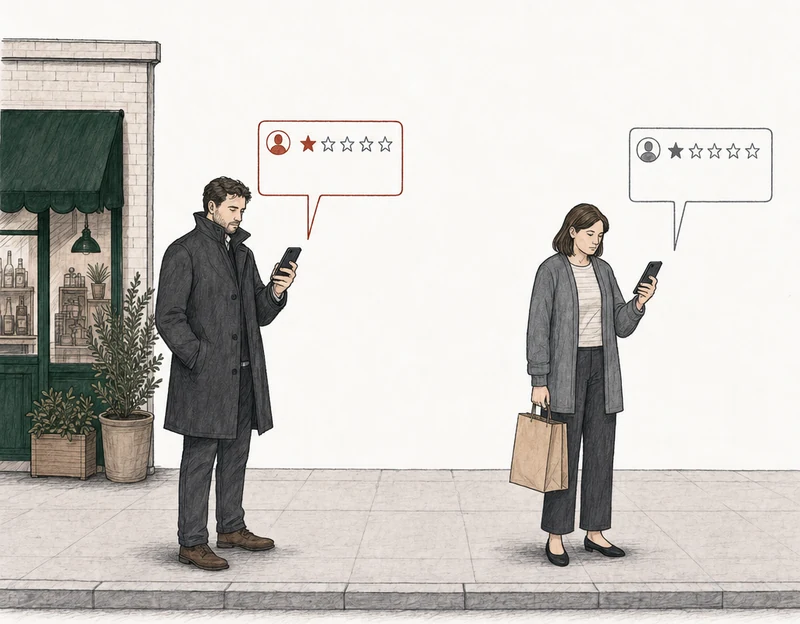
Four one-star reviews. Two you report. Two you answer in public.
Two one-star reviews. One you report. One you answer.
How do you respond to a bad Google review?
Before you respond to a bad Google review, find out whether it has grounds for removal. If it doesn't, write a short, calm reply in public. Write it for the next customer who reads it, not for the person who left it. Say what happened, say one plain thing you did about it, and give them a way to reach you.
That's two to four sentences. Google's own tips for owners come out close to the same place. Keep it short, be polite and honest, and move anything complicated to a phone call or an email (Google's tips for review replies). Your reply posts under the review, in your business's name, where anyone reading the review sees it (Google Business Profile Help).
If our analysis gave your review no grounds for removal, this page is for you.
Before you reply
What should you know before you reply to a bad review?
Two things. They change what you write, and sometimes whether you write anything at all.
Does the review have grounds for removal?
Find out before you reply. A reply can say things that a removal argument would later have to argue against. Say the review came from someone with no record of ever walking in. If your reply opens with "sorry about your visit on Tuesday," you've just confirmed in public that they were a customer. The argument you'd have made is that they never were.
So the order is to know first and reply second. It's free to find out whether your bad review has grounds for removal. And if it does have grounds, keep in mind that you get one appeal per review, ever. Our read is that the policy named has to match the argument. A careless reply can undercut the review's one appeal before you've filed it.
Is the review part of an extortion demand?
If a run of one- and two-star reviews showed up and then someone asked for money to make them go away, don't reply and don't pay. Report it. Google describes exactly that pattern, a sudden increase in low ratings followed by a demand for money, goods, or services to remove them, and tells owners plainly not to handle it on their own.

Google's help page for owners, on extortion scams.
Do not try to resolve it yourself by offering money or services.
Google Business Profile Help, Report negative review extortion scams on your Business Profile, section Report the extortion scam
Google's help text captured August 4, 2026.
Google also tells owners not to engage with the people behind it. We'd count a public reply as engaging. Google has a separate report for this, with its own evidence list, and it's covered on its own page, when a bad review comes with a demand.
What if the review breaks no Google policy?
Then there's nothing to report it on, and your reply is the response you have. Google doesn't remove reviews on "unfair." It removes them on policy. A real customer's bad day, told plainly, is a real review, even when it stings.
If you want the long version, there's a page on which bad reviews Google removes, one on who can actually get a Google review taken down, and the full list of the policies Google removes reviews under. Reporting a review that breaks none of them gives the report nothing to argue. What you can do is write a good reply.
When there are no grounds, that's the answer. Also free. Then the reply is the next thing to get right.
Or have us analyze it
Does your review have grounds, or does it need a reply?
We analyze every bad review on your profile against Google's written policies, free. Each review of 2 stars and below with at least ten characters of text comes back with a verdict. When none has grounds, leave an email and we send a draft reply for each one. Where there are grounds, we prepare the appeal and you file it from your own profile.
No email. No account. The answer is free either way.
Each review comes back with one of three:
Strong grounds for removalPossible grounds for removalNo grounds for removal
Write the reply
What should a reply to a negative review say?
Acknowledge what the review says happened. State one plain fact, or one change you made, that the review's own words support. Offer a direct way to talk. Keep it to two to four sentences. The person you're really writing to is the next customer, who reads the review and your reply together and decides what kind of business this is.
That's all there is to how to respond to negative Google reviews. Google says the middle part well.
Google's tips for review replies, on being honest about limits.
Be honest and explain limitations: Acknowledge if any mistakes were made, but don't take responsibility for things outside your control. Explain what you can and cannot do in that situation.
Google Business Profile Help, Tips to get more reviews, section Give helpful responses to negative reviews
Google's tips for review replies, fetched September 23, 2026. Not in the August 4, 2026 snapshot.
In our words, own the mistake if you made one. Don't apologize for the weather, the parking, or the supplier. And tell the reader what you do about it now, in one sentence. Responding to negative reviews goes wrong when the owner tries to win. The reader isn't scoring the argument. They're watching how you handle one.
What a reply to a bad review carries
- An acknowledgment. What they said happened, in a few words, with nothing private added.
- One fact or one change. Something the review's own text supports, stated once.
- A way to talk. A phone number or an email, so the rest happens off the page.
- Two to four sentences. Short enough that the next customer reads all of it.
What should you leave out of a reply?
Leave out argument, promises, private details, threats, and any talk of reporting or appeals. Above all, leave out any offer tied to the review. Offering to fix the problem is fine. Offering anything in exchange for a changed or deleted review isn't, and Google's policy says so directly.
Google's content policy, on what merchants may not do.
Offer incentives – such as payment, discounts, free goods and/or services - in exchange for posting any review or revision or removal of a negative review.
The rest of the extract
We do not allow merchants to:
Google's prohibited and restricted content policy, section Rating Manipulation
So a reply never asks the reviewer to update the review, and it never puts a refund or a free visit next to that ask. Google's tips also say to keep deals and promotions out of replies altogether (Google's tips for review replies).
Threats are the other hard line, and part of it is federal law. The FTC's Consumer Review Rule makes it an unfair or deceptive practice to use a groundless legal threat, intimidation, or a public accusation you know is false to try to get a review removed (16 CFR 465.7). A reply that makes a groundless legal threat to get the review down leaves you with the bad review plus a second problem.
What stays out of the reply
- Argument. No "that's not what happened," in any wording.
- Promises. Say what you changed, not what will never happen again.
- An offer tied to the review. No refund, discount or free service in exchange for an edit.
- Private details. Nothing from your records, and for a practice or firm, less still (below).
- Reporting and appeals. The reply isn't where you mention either.
- Threats. No lawyers, no legal action, no warnings.
What if the review gets the facts wrong?
State your fact once, plainly, and don't label theirs. If the review says you don't take walk-ins and you do, the reply says "We do take walk-ins, and on busy mornings the wait can run long." That's what Google's tips mean by explaining what you can and can't do. The next customer can put the two side by side. They don't need you to tell them which one to believe, and a reply that calls a review wrong reads worse than the review did.
What does a good response to a bad review look like?
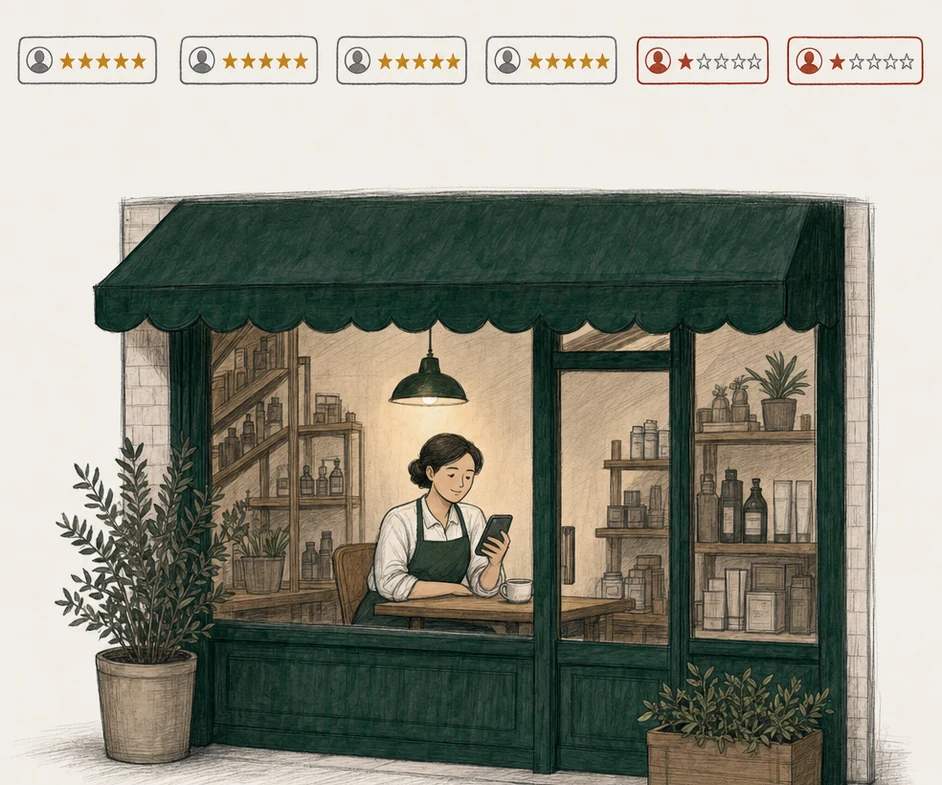
Here are three examples of negative review responses, all from the green-awning shop. Each one follows the two lists above. None argues, none promises, none offers anything, and none is over four sentences. The reviews are invented. They're examples, not templates, and the shape is the part to copy. When none of your bad reviews has grounds, the free analysis emails a draft like these for each one.
Three bad reviews and three replies
- A late order, made wrong. Thank you for telling us about the birthday order. It was late and it wasn't what you asked for, and that's on us. We now confirm every custom order by phone the day before pickup. If you'd like to talk it through, call the shop and ask for the owner.
- A price complaint. Thanks for the straight feedback on our prices. We price by the ingredients we use, and we know that puts us above some shops nearby. If you'd like to know what goes into a particular item, email us at the address on our profile.
- A one-star with no words. Thank you for the rating. We'd like to hear what happened on your visit, and we can't tell from the stars alone. Please call or email the shop and ask for the owner.
Post it
How do you reply to a Google review from your Business Profile?
To reply to a Google review, go to your Business Profile, select Read reviews, select Reply next to the review, type your reply in the box, and select Reply again. Your business has to be verified before Google lets you reply at all (Google Business Profile Help).
Open your profile
Go to your Business Profile.
Open your reviews
Read reviewsSelect Read reviews on your profile.
Pick the review
ReplyThe option sits next to the review you're answering.
Write it
Type your reply in the dialog box, then read it once more as the next customer would.
Post it
ReplyIt goes to Google before it shows up.
What happens after you reply to a bad Google review?
Google reviews your reply against its content policies before it posts. Google says that usually takes up to 10 minutes, but sometimes up to 30 days, and if the reply isn't approved you're asked to edit it. Once approved, it posts publicly under the review as your business, and your personal name isn't shown. The person who wrote the review gets a notification.
What happens after you reply, from Google's help page on managing reviews.
The customer is notified: The person who wrote the review is notified when you reply. Customers can still change their review after reading your reply.
Google Business Profile Help, Manage customer reviews, section Understand what happens to your replies
Google's help page on managing reviews, fetched September 23, 2026. Not in the August 4, 2026 snapshot.
So the reviewer finds out you replied. That's one more reason to write it calm. If they do change the review, its date changes to show the update (Google Business Profile Help).
Google reviews it
Usually up to 10 minutes, sometimes up to 30 days. If it isn't approved, you're asked to edit it.
It posts under the review
It appears as your business. Your personal name isn't shown.
The reviewer is notified
Google tells the person who wrote the review that you replied.
The review can still change
If they update it, the review's date moves to the update.
Can your reply get the reviewer to change the review?
Sometimes. Google's own tips say a constructive reply, and following up on the concern, may encourage a customer to update their review (Google's tips for review replies). The reviewer can edit or delete their own review from their own account (Google's Report or Fix Content help page). Google can remove it too, through a report or its own spam detection, but never because of your reply. So you ask for nothing and offer nothing. You fix what's real, answer well, and leave the decision to them.
Practices and firms
How do you respond to a bad review from a patient or client?
In health care and law, the reply shouldn't mention any detail of the person's care or their matter. For a lawyer, that includes a detail the client posted themselves. Keep it general: you take feedback seriously, and here's how to reach the office. Google's tips start from the same place.
Google's tips for review replies, on privacy.
Protect privacy and avoid personal attacks: Never share a reviewer's private information or engage in personal attacks. If a situation is complex, politely request that the reviewer contact you via phone or email to resolve the issue privately.
Google Business Profile Help, Tips to get more reviews, section Give helpful responses to negative reviews
For dental practices, federal regulators have enforced this. HHS's Office for Civil Rights settled with New Vision Dental in California for $23,000 and a two-year corrective action plan over patient information disclosed in replies to online reviews (HHS, 2022), and with Elite Dental in Dallas for $10,000 (HHS, 2019). The office's director put it in two sentences: "Providers cannot disclose protected health information of their patients when responding to negative online reviews. This is a clear NO."
For lawyers, the American Bar Association goes further in Formal Opinion 496. A lawyer who answers a review online can't disclose anything that relates to the client's matter, whatever its source, or anything that could reasonably lead someone to confidential information. In the opinion's words, lawyers "must not disclose information that relates to a client matter" in the response. What it does allow online is an invitation to talk privately, or a line saying professional obligations prevent a reply, and it tells lawyers to consider ignoring a negative review (ABA Formal Opinion 496).
Google's tips also suggest addressing the reviewer by name and signing off with yours. For a dental or medical practice, skip the name. Both HHS cases started with a complaint that the practice's replies disclosed patient names. This isn't legal advice, and your own profession's rules govern. There's more on replying to patient reviews as a dental practice, answering client reviews as a law firm, and replying to reviews as a veterinary clinic.
When there are no grounds
What do you get when the analysis finds no grounds?
A plain answer and a reply for each review. We analyze every bad review on your profile against Google's written policies, which means every review at 2★ and below with at least ten characters of text. When none of them has grounds, we say so, and there's nothing to appeal and no appeal to buy. Leave an email and we send the playbook. For each review we analyze, the playbook has the verdict, why, and a draft reply written to the rules on this page. A review with too little text to analyze gets a draft reply. If you've already replied to some of these reviews, the drafts match the tone of those replies.
About six in ten profiles we analyze have no review with grounds for removal. We say so plainly, with a reply playbook attached. You can read the rest of the numbers we publish and how our analysis is measured.
The full walk-through is what the free analysis sends back.
Common questions about responding to bad Google reviews
What should you write in response to a 3-star review?
The same shape, with one difference. A three-star usually says something went right, so thank them for that part, answer the part that didn't, and give them a way to reach you. Two to four sentences. Our analysis covers 2★ and below, so a three-star isn't one we analyze, and it's rarely one you'd report.
Should you reply to every bad Google review?
Yes, once you know it has no grounds, including a one-star with no words, like the third example above. Google's own tips call replying to reviews a best practice (Google's tips for review replies). The effect of reviews on your average is its own subject, covered on the page about improving your Google rating.
How quickly should you respond to a bad review?
Google says to respond in a timely manner and gives no number of hours. Our order is to find out whether the review has grounds first, then reply.
Can you edit or delete your reply later?
Yes. Go to your Business Profile, select Read reviews, and under your reply select Edit to change it or Delete to remove it (Google Business Profile Help).