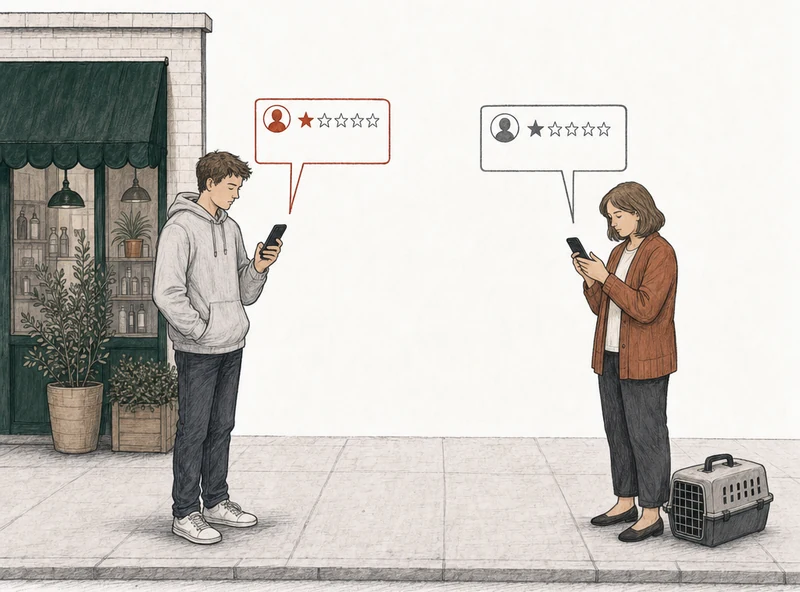
It can be, but not because the person was never a client. Google has no policy section named "fake reviews." Two of its policies fit a review from someone who was never in the building, Off-topic and Fake Engagement, and both turn on what the review says. For those two, the review's own words decide it. Most bad reviews have no grounds. The policies below are the ones that reach a clinic's reviews, and whether your clinic's reviews have grounds for removal has the short answer.
Watch who says "never a client." When the review says it, the evidence is in the review. When you say it, it's your records against their word, and the appeal form has no place to attach your records.
Off-topic. Google asks for reviews based on the writer's own experience at the place. It doesn't allow general or social commentary, or personal rants. A one-star whose writer says they've never been a client and is going on a neighborhood-group post falls here. So does a post about what vets charge that describes no visit. The wording is short, and the off-topic rule has it with examples.
Fake Engagement. This covers content that isn't based on a real experience, or that doesn't accurately represent the place. On a vet clinic's profile, that's a one-star that names a different clinic. The other clauses are on the page for the fake engagement policy.
Rating Manipulation. Google's rule covers unusual volumes or patterns of reviews that point to an effort to manipulate a place's rating. That's the wave, and it's covered just below. The same section covers reviews based on a conflict of interest, such as one from a competing clinic. That one turns on who wrote it, which usually takes evidence from outside the review. Our verdict on one is never above possible grounds.
Harassment. Google doesn't allow content posted to harass people or businesses, or content that encourages others to join in. It includes a specific threat of harm against someone at the clinic, the kind that would make a reasonable person fear for their safety. An angry review doesn't reach it, and neither does a threat to complain.
Personal information. A review that names the veterinarian is ordinarily fine. Google allows the name of a public-facing professional who does business under that name. A review that posts where one of your techs lives is different, and that falls under this policy.
These are all in Google's policy text.
The wave as a whole is something Google's Rating Manipulation policy names: unusual volumes or patterns meant to move a place's rating. Spotting that across accounts is Google's job. We can't see who is behind a wave.
Every review in the wave with at least ten characters of text gets its own verdict. Star-only reviews are counted, not analyzed. The wave doesn't change what any single review says. A few may say outright that the writer was never there. Others read like a visit, and those get the same verdict a client's review would. Our analysis doesn't treat several reviews of the same visit as fake engagement on their own, because a family that came in together can each post about it.
If someone then asks for money, a refund or free care in exchange for taking the reviews down, that's a different problem with its own Google form. Google says an extortion scam can start with a sudden run of 1-star and 2-star reviews, followed by a demand, and it tells owners not to engage or pay. The steps are in review bombing and extortion on Google.