Google review policies/Fake engagement

Google's Fake Engagement policy. What it covers in a review.

Reviewed by Doug Baker, founder · Updated September 23, 2026 · Policy text snapshot August 2026

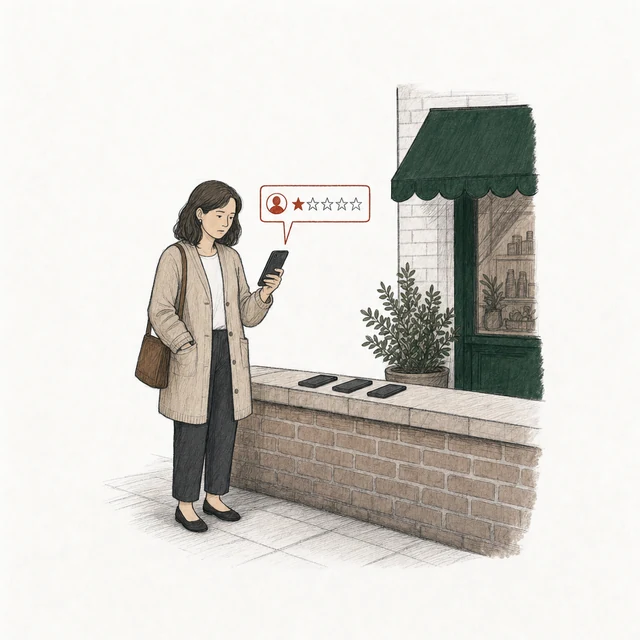
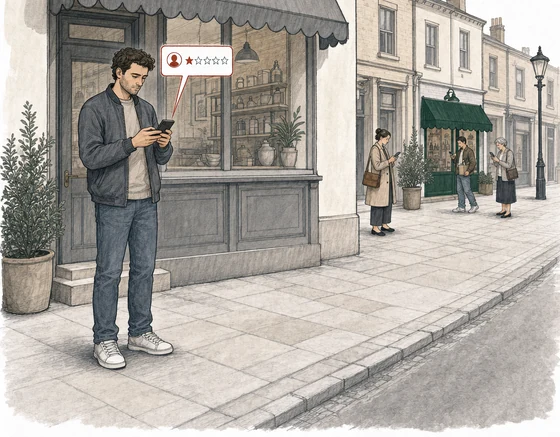
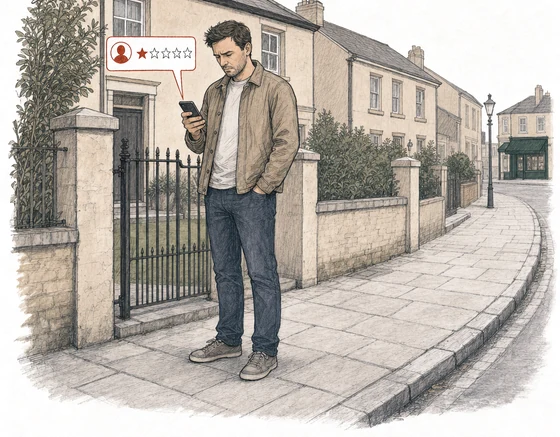
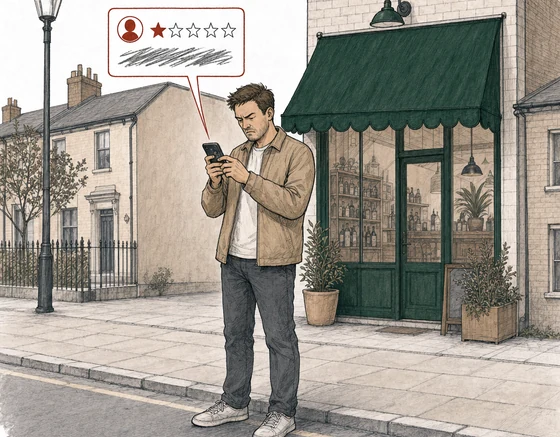
Illustration: a street with a small shop under a green awning and, to its right, a smaller rival shop under a gray awning. Five people post a one-star review from a phone. Four of the review cards are drawn in red and labelled with what puts the review under the policy: No real experience, a young man in a hooded sweatshirt standing well away from the shops; Paid for, a man with a paper envelope under one arm; Several accounts, a woman beside a low wall with three more phones lying on it; Competitor, the rival shop's owner in a gray apron in his own doorway. At the far right, apart, an ordinary customer with a takeaway coffee cup posts a one-star review drawn in plain gray, labelled Real customer.
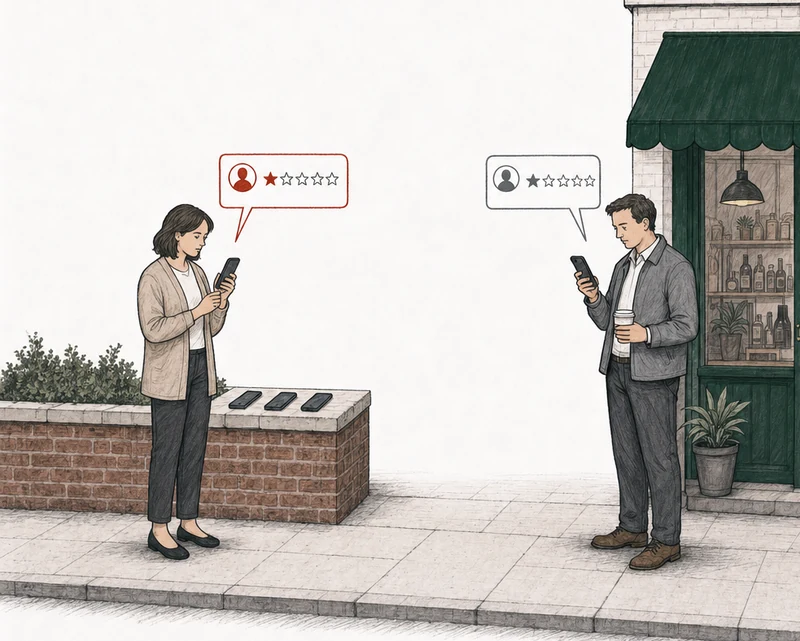
Illustration: two people on the pavement, each posting a one-star review from a phone. At the left, a woman in a cardigan beside a low wall with three more phones lying on it; her review card is drawn in red. At the right, apart from her, by the green-awning shop, an ordinary customer with a takeaway coffee cup; his review card is drawn in plain gray. Labels: Several accounts, Real customer.

The policy reaches four of these five reviews, each under its own clause. It doesn't reach the real customer.

The policy reaches the one posting from several accounts. It doesn't reach the real customer.

Fake engagement is Google's name for a review that isn't based on a genuine experience. Someone who was never there. Someone who was paid. One person posting from several accounts. The policy names each of those, and a few more. It says nothing about how harsh a review is, so a brutal review from a real customer isn't fake engagement. Another policy might reach it. This one doesn't.

Two similar reviews. One breaks the policy.

Same business, same star count, same tone. One admits there was no visit. The other describes one.

Breaks the policy

Trevor M.
Strong grounds for removal
★★★★sample

I've never been here, but I heard the owner is rude and the prices are a rip-off. Don't bother.

Fake EngagementNo real experience

Breaks it. The first sentence says there was no visit, and the policy covers a review with no real experience behind it.

Doesn't break it

Dana W.
No grounds for removal
★★★★sample

The coffee was cold and nobody apologized when I mentioned it. Won't be back.

Does not coverReal customer

Doesn't break it. It's a real visit, described, so we'd tell you no for free rather than spend your one appeal on it.

The policy

Fake engagement in plain terms

A review has to come from a genuine experience with your business, written by the person who had it, on their own account, and not paid for. It also has to describe your business accurately. If it fails any of that, this policy reaches it and Google removes it. The star rating doesn't matter here, and neither does how harsh the review is.

Breaks the policy

  1. A young man in a hooded sweatshirt, alone on an empty stretch of pavement, posts a one-star review; the shop is far down the street behind him.

    No real experience

    No real experience behind it.

    "I've never been here, but I heard the owner is rude."

  2. A man in a plain jacket with a paper envelope under one arm posts a one-star review; the corner of the shop is behind him.

    Paid for

    Bought or traded for.

    A one-star someone was paid to leave, or a discount offered in exchange for posting one, revising it, or taking it down. The offer is a violation on its own.

  3. A woman in a cardigan posts a one-star review from one phone while three more phones lie in a row on the wall beside her; the corner of the shop is behind her.

    Several accounts

    One person, several accounts.

    Three one-stars from three accounts, all posted by one person or because one person asked.

  4. A rival shop owner in a gray apron, in the doorway of his own shop, posts a one-star review; the green-awning shop is across the street.

    Competitor

    A competitor posted it.

    Google names this one outright. Content posted on a competitor's business to undermine it. So if a rival left it, that's covered by name.

  5. A customer with a takeaway coffee cup, just outside the shop, posts a one-star review drawn in plain gray.

    Real customer

    Does not cover

    A real customer who is angry or unfair to you. That's still a genuine experience, and this policy doesn't reach it.

Does yours break it?

What does not count as fake engagement?

Google doesn't remove reviews because you say they're fake. It removes them when the evidence shows a policy violation.

A name that appears nowhere in your records is one piece of evidence, not the violation by itself. Whether the evidence adds up is the first question, and whether your Google review can be removed walks through it from the top.

Google's glossary says a genuine experience is the reviewer's own experience at the place they're reviewing. A customer who was there and remembers the visit differently than you do had one. Google's reporting page says it from the other side. Disagreeing with a review, or not liking it, isn't a reason to report it. And further down the same policy, under Offensive content, Google says a negative experience told respectfully is allowed. A one-star with no text is the hard one. There's no sentence to quote and nothing to check.

This cuts both ways. One owner on Google's own Business Profile community describes a legitimate review getting flagged as fake engagement.

No grounds for removal

So we won't tell you a review has grounds when it doesn't. When there are no grounds, that's the answer. Also free.

Google's wording, unedited

The clause the pair above turns on. The section's opening line, its other three clauses, and the three rules for merchants and users are in the extract.

Content that is not based on a real experience or does not accurately represent the location or product in question.

The rest of the extract

Contributions to Google Maps should reflect a genuine experience at a place or business. Fake engagement is not allowed and will be removed.

This includes:

  • Reviews or ratings that have been paid for, directly or in kind.
  • Content that has been posted from multiple accounts by or at the request of one person.
  • Content that has been posted using an emulator or other device tampering service, modified operating system, or other method to mimic genuine engagement, manipulate sensor data or results, or otherwise thwart or confuse normal operations.

We do not allow merchants or users to:

  • Solicit or encourage the posting of content that does not represent a genuine experience.
  • Offer incentives – such as payment, discounts, free goods and/or services - in exchange for posting any review or revision or removal of a negative review.
  • Post content on a competitor’s place or business to undermine that business’ or product’s reputation.

Google, Maps user-generated content policy, Prohibited & restricted content, section Fake Engagement

Google's policy text captured August 4, 2026. Section headings re-checked against the live page September 3, 2026.

Common questions

  • Is a review from someone who was never a customer fake engagement?

    Sometimes. The clause is about the experience behind the review, so the argument needs the reviewer's public history alongside your records. An empty records search on its own is thin.

  • Can a competitor's review be removed?

    Google decides. Google does name content posted on a competitor's business to undermine it. But where the reviewer is a competitor, the conflict-of-interest clause usually argues better. The appeal we prepare won't claim more about who's behind the account than the evidence shows.

  • What happens to a business that buys reviews?

    Google may put restrictions on the Business Profile on top of removing the reviews, like blocking new reviews for a period. Paying for reviews, or asking for ones that don't come from a real experience, breaks this same policy on your side of it. Asking customers to review a genuine experience is allowed, as long as you offer nothing for it, don't try to steer the rating or the words, and don't ask only the happy ones. Burying a bad review under bought ones isn't a way out.

File it yourself

How do you report a Google review for fake engagement?

Open your Business Profile, go to Read reviews, hit Report next to the review, pick Spam as the reason, and send it. The status shows up in the Reviews Management Tool, and Google says evaluation typically takes several days. That's the only timeline Google publishes.

  1. Open Read reviews

    In your Business Profile, find the review

  2. Select Report, pick a reason

    The pick can limit what the appeal may argue

  3. Send it, then wait

    Typically several days, Google says.

    Decision pending
  4. If it stays up, the appeal

    Report reviewed - no policy violation

    One per review, ever. You file it.

The report, then the appeal. Drawn by us, not a screenshot of Google.

Why Spam? Google publishes two example reasons, Spam and Profanity, and for fake engagement Spam is the closer of the two, so that's the one we have you pick when you report. There's a gap here worth knowing about. Google doesn't publish the full menu. It doesn't publish what the appeal form asks you for either. You find out when you open it.

The appeal is where the argument goes. The one we prepare names Fake Engagement in its first sentence and quotes the review's own words. Then it puts what the account's public history shows next to what your records show. A name missing from your records isn't the violation by itself, so the appeal never rests on that alone.

And there's a catch. Google gives you the one-time Google review appeal, one per review, ever. You name a policy when you file. Name one that doesn't match your argument and that can waste the one appeal you have. So the filing is the whole job. You file it from your own profile. We never submit anything to Google.

What evidence does a fake engagement appeal need?

Words, not attachments. The appeal is a free-text form with no upload field, so whatever you have, you have to write it out in the box.

BrightLocal's removal guide lists what an owner can actually point to.

What an owner can point to

  • The review saying outright that the writer never dealt with you.
  • A run of one-stars in a short stretch, when that's unusual for your business.
  • A reviewer whose name is your competitor's.
  • A social post asking people to go leave the reviews.

TrueReview writes out a sample appeal sentence built from the account itself: how new it is, how many businesses in how many cities it reviewed in the same week, and that your records show no transaction with that person.

The limitThe weak point is authorship. You can describe an account's public behavior and your own records, and that's it. The appeal we prepare never claims more about who wrote the review than that evidence shows.

Or have us analyze it

How do you check whether a review matches Google's fake engagement policy?

Put in your business name and we'll analyze every bad review on the profile against Google's written review policies, not this one alone. We read reviews at 2★ and below that carry at least ten characters of text, and you get a verdict on each one: strong grounds for removal, possible grounds, or no grounds. About six in ten profiles we analyze have no review with grounds for removal. That's worth knowing, because it keeps your one appeal for a review that can use it. Where there are grounds, what the free analysis covers walks through what we prepare and what you file. Nothing is behind a call.

No email. No account. The answer is free either way.

Each review comes back with one of three:

Strong grounds for removalPossible grounds for removalNo grounds for removal

The shop owner sits at a table inside the shop after closing, reading her phone. Above the shop floats a row of six review cards: four with five gold stars, two one-star cards drawn in red.

Which other Google review policies could apply?

A review can break more than one section, and fake engagement often isn't the strongest one. Spam is one of the two report reasons Google names, and the same text posted from several accounts also falls under Google's rules on repetitive content. So start with spam in Google reviews. Where a competitor, a former employee, or a family member left it, Google's conflict-of-interest clause names that relationship outright and usually argues better. A review posted in a real person's name by someone else falls under Google's impersonation policy. All ten categories we cover sit in the Google review policy index. If a demand for money or free work is sitting behind the reviews, that's review extortion on Google, and Google runs a separate channel for it. We're writing a walkthrough of how to remove fake Google reviews.

RatingMinder