Google review policies/Policy changes
Google review policy changes. What we've checked, and when.
Reviewed by Doug Baker, founder · Updated September 22, 2026 · Policy text snapshot August 2026

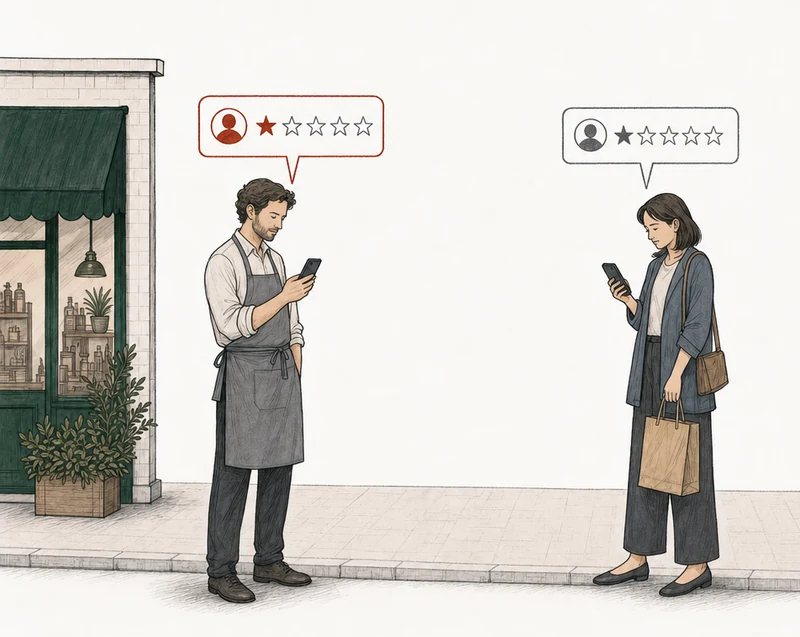
Two one-star reviews. One falls under a rule about who wrote it. The other doesn't.
Two one-star reviews. One falls under a rule about who wrote it. The other doesn't.
Google doesn't publish a dated list of changes to its review policies, so we keep our own. On August 4, 2026, we saved the text of 19 of Google's policy and appeal pages, and each check since then is dated below. The last one ran September 3, 2026. The headings on Google's "Prohibited & restricted content" page all matched our copy. We saw no change.
What has changed in Google's review policy since August 2026?
Nothing we've seen, as of September 3, 2026. That day we compared the section headings in our saved copy of Google's "Prohibited & restricted content" page, the one that holds the review rules, with the live page. Every heading matched.
That check covered the headings, not every sentence under them. A clause reworded inside a section wouldn't show up in it. Here's the whole log. Each check gets one line.
What we checked, and what we found
- August 4, 2026 Baseline captured: 19 of Google's policy and appeal pages, saved as plain text. The copy every policy page on this site quotes.
- September 3, 2026 The section headings of Google's "Prohibited & restricted content" page, against the live page. No change. Every heading matched our copy.
- September 23, 2026 The Misinformation and Misrepresentation sections of Google's "Prohibited & restricted content" page, word for word, against the live page. No change. Both sections matched our copy word for word.
Google's policy text captured August 4, 2026. Section headings re-checked against the live page September 3, 2026.
Why the wording matters
Why does a change in Google's wording matter for a bad review?
Because grounds for removal come from Google's wording. When we analyze a bad review, we read it against Google's written policies, and an appeal quotes the clause it relies on. Google allows one appeal per review, ever. Our read is that the policy named has to match the argument.
So if Google rewords a category or drops one, an appeal written to the old wording can name a policy that no longer says what the appeal quotes. That can waste the one appeal you have. That's why every policy page here prints two dates under Google's wording, the day we captured it and the day we last re-checked the headings. They tell you how old the text is, and they link to this log.
If you came here about one review in particular, you can see whether your review has grounds for removal without reading any of this.
What was Google's April 2026 review policy update?
Two rules about how a business asks for reviews. Under "Rating Manipulation", a business can't ask its staff to bring in a set number of reviews. It also can't ask them to collect reviews that say particular things, including a staff member's name. ppc.land reported that Google Product Expert Amy Toman spotted both on April 17, 2026.
Our log starts August 4, so we can't date them ourselves. What we can say is that both are in our August snapshot. Google's own post on April 16, 2026 is about something else. It describes detection for scam patterns, screening of edits, and email alerts to verified owners. It doesn't name a change to the policy text.
Both rules cover how you ask for reviews. They say nothing about the person who wrote about you. The same section also holds Google's conflict-of-interest rule, which is about who wrote the review, and that one can give grounds for removal. The longer list of dated changes that other people have reported is on our Google review policy pages.
How we check
How do we check Google's review policies for changes?
We keep our own copy of Google's policy text and compare the live pages against it. Google doesn't publish a dated list of changes, so that comparison is the only record we have. On August 4, 2026, we saved 19 of Google's pages as plain text.
Those include the overview of Google's Maps user-generated content policy and its "Prohibited & restricted content" page, the Business Profile help pages on reporting and managing reviews, and the glossary pages that define Google's policy terms.
To check, we fetch the pages again and compare the text with that copy. When a category is added, removed, or reworded, it goes in the log on this page with its date, and we update our analysis to read reviews against the new wording. We don't promise a schedule. The log is the record of when a check ran. If a date isn't on it, we're not saying a check ran.
What can a text check miss?
The Reviews Management Tool. That's where you report a review and follow what Google did with it. It sits behind your Google sign-in, so there's nothing for us to fetch and compare. The only way to see a change there is to sign in and walk through it.
Google's help page on reporting a review is public, and it's in our snapshot. The tool it sends you to isn't. You file from your own profile, and we never submit anything to Google. If you want the steps, here's who files the appeal, and how.
Or have us analyze it
How do you check a review against the policy as it stands today?
Type in your business name and we'll analyze every bad review on the profile against Google's written policies, the same text this log tracks. Each review gets a verdict, free, and the verdict tells you whether it has grounds for removal and how strong they are. Where there are grounds, we prepare the appeal and you file it. When there are no grounds, that's the answer. Also free.
No email. No account. The answer is free either way.
Each review comes back with one of three:
Strong grounds for removalPossible grounds for removalNo grounds for removal