Google review policies/Conflict of interest

Conflict of interest in a Google review. What Google's policy says.

Reviewed by Doug Baker, founder · Updated September 23, 2026 · Policy text snapshot August 2026

Illustration: a street with a small shop under a green awning. Seven people stand on the pavement, each posting a one-star review from a phone. Six of the review cards are drawn in red and labelled with who the writer is: Competitor, a rival shop owner in a gray apron in front of his own shop; Any other public tie, his wife beside him; Current employee, a worker in the shop's green apron in its doorway; Former employee, a person in street clothes carrying a box of belongings; Contractor, a tradesman with a toolbox; Relative, an older woman. At the right, an ordinary customer with a shopping bag posts a one-star review drawn in plain gray, labelled Customer.
Illustration: two people on the pavement, each posting a one-star review from a phone. At the left, by the green-awning shop, a former employee carrying a box of belongings; his review card is drawn in red. At the right, apart from him, an ordinary customer with a shopping bag; his review card is drawn in plain gray. Labels: Former employee, Customer.

Five of them have a tie the clause names, and in our read it reaches the competitor's wife too. Not the customer.

The clause reaches the former employee. It doesn't reach the customer.

There is no policy called conflict of interest. There's one clause, two sentences long, and Google prints it twice on the same page, once under Rating Manipulation and once under Misrepresentation. It's about who wrote the review. A former employee. Someone you had a contract with. A competitor. A relative. Conflict of interest is our name for the group. The section names are Google's.

Two similar reviews. One breaks the policy.

Same profile, same one star, same annoyed tone. One of them tells you who the writer is to the business. Both invented.

Breaks the policy

Wes T.
3 reviews
Possible grounds for removal
★★★★2 weeks agosample

Ran their install crew on a subcontract all last season, so I've seen how they treat the people who work for them. Jobs got moved on us twice a week and payment ran past sixty days every time. Save yourself the trouble.

Rating ManipulationContractor

Breaks it, because the clause names "a contractual or consultory relationship" and the review admits one in its first line. Appeals like this sometimes succeed, not usually.

Doesn't break it

Nina R.
8 reviews
No grounds for removal
★★★★1 month agosample

Booked the 8 to 11 window and nobody came until after four. When I called about it the guy talked over me and hung up.

Does not coverCustomer

Doesn't break it. She's describing a job she paid for and a day that went badly.

The policy

Conflict of interest in plain terms

The clause turns on a relationship. It covers a review written out of the writer's stake in your business, meaning some tie other than being a customer. The star rating doesn't matter. Google's glossary files this under Incentivized or Biased Reviews and describes a biased review as one swayed by a conflict of interest, personal or professional. Bias is the test. Tone isn't.

Breaks the policy

  1. A current employee in the shop's green apron posts a one-star review from its doorway; a former employee in street clothes walks away carrying a box of belongings, posting one too.

    Current employeeFormer employee

    Current or former employment.

    A one-star from the person who ran your front counter last spring. That lane has its own page, a former employee's Google review.

  2. A tradesman in work clothes beside his white work van, toolbox at his feet, posts a one-star review; the corner of the shop is behind him.

    Contractor

    A contract or consulting relationship.

    The subcontractor you stopped hiring, reviewing you about payment terms rather than a service they bought.

  3. A rival shop owner in a gray apron, in the doorway of his own shop, posts a one-star review; the green-awning shop is across the street.

    Competitor

    Industry competitors.

    The clause names them outright. Someone who runs the same trade two towns over and has never been a customer.

  4. An older woman arm in arm with her grown son outside the shop posts a one-star review.

    Relative

    Familial relationships.

    Named in the same parenthetical, right after competitors. In our read a relative's review falls under it whichever way the stars point.

  5. A woman in a coat posts a one-star review a step from a rival shop, where her husband stands in the doorway in a gray apron; the green-awning shop is across the street.

    Any other public tie

    Any other professional or personal tie.

    The catch-all. In our read it reaches a competitor's spouse, when the tie is one anyone can look up and not one you're pretty sure about.

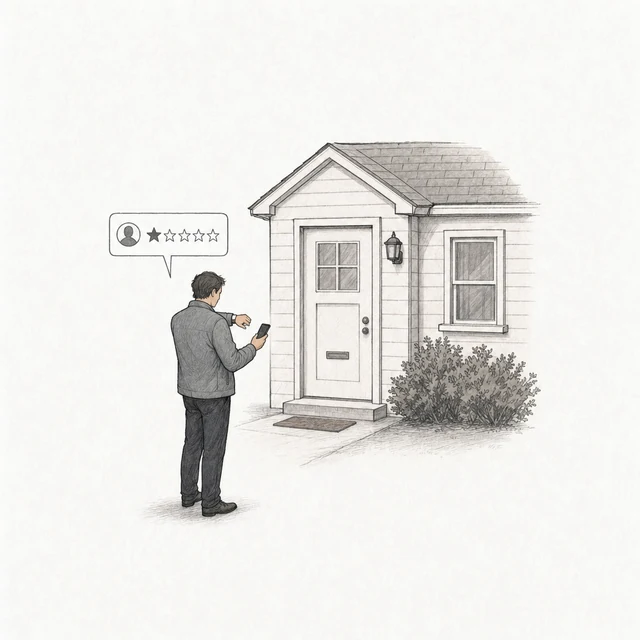
  6. A customer at the door of a house checks his watch after waiting all morning and posts a one-star review, drawn in plain gray.

    Customer

    Does not cover

    A customer who had a bad time and said so. This clause doesn't reach those, however harsh they read.

Rating Manipulation sounds like the wrong section for this until you read Google's definition of it. It covers any attempt to move a place's star rating, directly or indirectly, through fake and misleading content, and Google counts a biased review as one of the ways that happens.

Google doesn't remove a review because the person who wrote it had a stake. It removes reviews that break a policy, and this clause is where having a stake becomes a policy question. Whether that ends with anything coming down is the wider question, and whether your Google review can be removed answers it from the top.

Does yours break it?

What is not a conflict of interest?

A negative review from an actual customer. The clause is about a relationship other than the customer one, so a bad experience told badly sits outside it no matter how much it stings.

Google makes the same point from the other side on its reporting page. It tells owners not to report a review only because they dislike it or don't agree with it, and it stays out of arguments between businesses and customers.

The rule for you, the owner

Neither section gives the reviewer any exception. The one thing Rating Manipulation does allow is a rule for business owners, and it applies to you, not to the person who wrote about you.

  • You can ask customers for reviews, as long as you're asking for a genuine experience and not steering the rating or the wording.
  • You can't offer anything for a review, or for revising or taking one down.
  • You can't discourage the negative ones or only ask the customers you know are happy.

The reviewer-side allowance lives in a different section, Offensive content, where Google says it allows content describing negative experiences in a respectful manner.

No grounds for removal

So an honest negative is a no here, and we'll say so. When there are no grounds, that's the answer. Also free.

Google's wording, unedited

Rating Manipulation first. This is an extract, and it stops at the clause. Three of the section's rules for business owners are up the page, in our words.

Content that is based on a conflict of interest. A conflict of interest may include current or former employment, a contractual or consultory relationship, or other professional or personal affiliations that demonstrate a conflict of interest (such as industry competitors, familial relationships, etc.).

The rest of the extract

Contributions to Google Maps should reflect a genuine experience at a place or business. Rating Manipulation includes Incentivized or Biased Reviews, which are not allowed and will be removed from Maps.

This includes:

  • Content that has been posted due to an incentive offered by a business - such as payment, discounts, free goods and/or services.
  • This includes content posted following requests for revision or removal of a review or rating in exchange for an incentive.
  • Content exhibiting unusual volumes or patterns of review contributions that are indicative of efforts to manipulate a place’s rating

Google, Maps user-generated content policy, Prohibited & restricted content, section Rating Manipulation

The same clause again under Misrepresentation, this time without the parenthetical.

Content that is based on a conflict of interest. A conflict of interest may include current or former employment, a contractual or consultory relationship, or other professional or personal affiliations that demonstrate a conflict of interest.

Google, Maps user-generated content policy, Prohibited & restricted content, section Misrepresentation

Google's policy text captured August 4, 2026. Section headings re-checked against the live page September 3, 2026.

Common questions

  • Can a competitor leave a review of your business?

    Not one that comes out of the rivalry. The clause names industry competitors, and Google's fake engagement section separately bars anyone from posting on a competitor's listing to damage its reputation. What carries the argument is the affiliation, and in our read that means one anyone can look up, not a suspicion. The argument, with the evidence it needs, is on a review from a competing business.

  • Can a family member review a business?

    The clause names familial relationships, so it can reach them. The evidence problem is the same. In our read it has to be something a stranger at Google can check, not something you happen to know.

  • Does the review have to say what the relationship is?

    No, but an admission inside the review text is the best evidence you can bring, because Google can see it without taking your word for it. Without one you're working from a public affiliation and your own records, and that's a thinner argument. Even with one, we mark these possible grounds, not strong, and we tell you why before you pay.

File it yourself

How do you report a Google review for a conflict of interest?

From your Business Profile. Open Read reviews, select Report next to the review, pick a reason, send it. You can report any review, but Google's rules only let it remove the ones that break a policy.

  1. Open Read reviews

    In your Business Profile, find the review

  2. Select Report, pick a reason

    The pick can limit what the appeal may argue

  3. Send it, then wait

    Typically several days, Google says.

    Decision pending
  4. If it stays up, the appeal

    Report reviewed - no policy violation

    One per review, ever. You file it.

The report, then the appeal. Drawn by us, not a screenshot of Google.

Google's help page says evaluation typically takes several days. That's the only timing it publishes. The Reviews Management Tool shows Decision pending until someone looks, then Report reviewed - no policy violation if Google looked and left the review up.

Picking the reason is the hard part with this one. Google documents two example reasons, Spam and Profanity, and doesn't publish the rest of the menu. Moderators on the Local Search Forum found a Conflict of interest reason in some accounts in June 2025 and not in others. If yours shows it, use it. If it doesn't, a moderator there says to pick the closest match at the flag stage and name the specific policy in the appeal, because the appeal is where you get to name it. One moderator in that thread filed employee reviews under Low quality information, a reason whose description includes off-topic reviews.

The appeal is where this gets decided, and you get one. Google's one-time review appeal is one per review, ever. It names a policy. Name one that doesn't match your argument and you can waste the one appeal you have. In our read, an appeal on a competitor or an affiliation review should name Rating Manipulation and quote the clause rather than argue bias in general. Misrepresentation carries the same clause without the parenthetical, so either section supports the argument, but name the one you're quoting. Then spell out who the writer is to your business. Here's how. You file it from your own profile. We never submit anything to Google.


What evidence does a conflict-of-interest report or appeal need?

It's all words. There's no upload, and Google publishes no field list for the appeal form, so whatever you have has to be written out in sentences.

What goes in the box

  1. Write down who the person is to your business.
  2. Write down what the review actually talks about, which here is a working or contract relationship rather than something they bought.
  3. And write down what your records don't have, which is a sale under that name.

Before you reportYou should save the review and the reviewer's public profile before you report anything, so you still have them if either one changes.

The limitWe don't identify anonymous accounts. If you can't show who the person is, in our read that's a no.

BrightLocal's removal guide, updated November 2025, gets at the same thing with a list of questions. Does the name match any records you have? Does the review say or imply the person worked for you? The guide also tells the story of a lawyer who supplied court records showing the reviewer's name matched the other side in a court case.

Not much is known about how Google handles these now. In July 2025 an owner on the Local Search Forum said a conflict-of-interest report had sat at Decision pending for almost two months, and Tim Colling, a moderator there, replied that Google "seems to have stopped removing 'conflict of interest' reviews now". A month earlier, in another thread, a member said they were still seeing examples come down. That's a handful of forum posts, not a removal rate. We don't publish a removal rate for this category, and Google decides on what's in front of it.

Or have us analyze it

How do you check whether a review breaks this clause?

Type in your business name. We analyze every negative review on the profile against Google's written policies, not this clause alone, because a review that trips this one often trips a second. We read reviews at 2★ and below that carry at least ten characters of text, and each one comes back with a verdict: strong grounds for removal, possible grounds, or no grounds. Where there are grounds, we prepare the appeal and you file it. If you want the mechanics first, what the free analysis looks for walks through every step. Nothing is behind a call.

No email. No account. The answer is free either way.

Each review comes back with one of three:

Strong grounds for removalPossible grounds for removalNo grounds for removal

The shop owner sits at a table inside the shop after closing, reading her phone. Above the shop floats a row of six review cards: four with five gold stars, two one-star cards drawn in red.

Which other Google review policies could apply?

A review can break more than one section, and the relationship isn't always the strongest thing you have. If the review describes no real experience anywhere, Google's fake engagement policy reaches it directly. If it describes nothing that happened at your location, that's Google's off-topic policy. And if the writer is posing as a specific person or company, name Google's impersonation policy. Every Google review policy category sits on one page, in Google's own words.

RatingMinder