Special cases/Review bombing

Review bombing on Google Business Profiles. What to file.

Reviewed by Doug Baker, founder · Updated September 23, 2026 · Policy text snapshot August 2026

Illustration: a street with a small neighborhood restaurant under a green awning. Five people, each posting a one-star review from a phone. Four of the review cards are drawn in red. Three strangers stand along the pavement to the left of the restaurant, and each of their cards is labelled Never visited. A man sits on a low wall with three more phones laid out beside him, and his card is labelled Several accounts. At the right, just outside the restaurant's door, a customer holding a takeaway bag posts a one-star review drawn in plain gray, labelled Real customer.
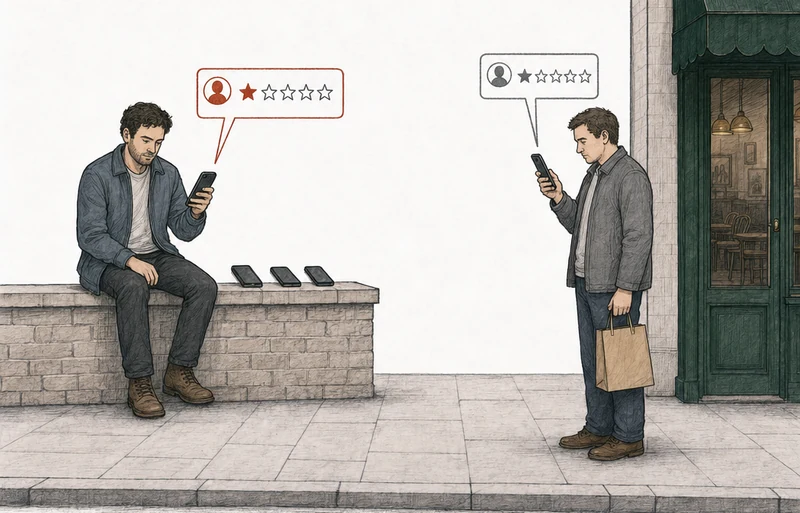
Illustration: two people on the pavement, each posting a one-star review from a phone. At the left, a man seated on a low wall with three more phones laid out beside him; his review card is drawn in red. At the right, apart from him, by the green-awning restaurant's door, a customer holding a takeaway bag; his review card is drawn in plain gray. Labels: Several accounts, Real customer.

Google's fake engagement policy reaches the reviews that describe no visit and the accounts one person runs. It doesn't reach the customer who came in.

The policy reaches the one posting from several accounts. It doesn't reach the customer who came in.

Review bombing is a wave of bad reviews posted for some reason other than a visit. Google has no rule called review bombing. You report each review in the wave on its own, and one that describes no visit falls under Google's fake engagement policy. Most of what's written about the term, including Wikipedia's entry, is about games and films. When a Google Business Profile gets review bombed, it looks like this. Twenty one-stars landed in three days, from names you can't find in your records. Google removes the ones that break a policy. The rule against reviews with no real experience doesn't reach a real customer's review of an actual visit. If someone asked you for money to take them down, that's extortion, and Google has a separate form for it.

Does yours break it?

Which Google policy covers a review bomb?

Fake engagement. Google's Prohibited & restricted content policy says a review has to come from a genuine experience, and a review with no real experience behind it breaks that rule. The star rating doesn't matter, and neither does how harsh the review reads.

Owners call it a review bomb or a Google review attack. Google sees separate reviews, and the policy reaches each one through a different clause, depending on how the wave started:

  • People who never came in, posting after something they saw online. No real experience, so the first clause covers them.
  • One person posting from several accounts, or several accounts posting because one person asked. Google names that outright.
  • Someone rallying others to post. Google doesn't allow anyone, merchant or user, to encourage reviews that don't reflect a genuine experience.
  • Reviews someone paid for, or reviews a competitor posted to hurt your reputation. Google names both.

Here's the limit. The policy reaches a review, not a wave. A real customer who ate at your place last month and joins the pile-on is still a real customer, and the clause about reviews with no real experience doesn't reach that review. Our page on what fake engagement covers walks through each clause.

Google also has a clause about unusual volumes or patterns of reviews aimed at a place's rating. It sits in a different section, Rating Manipulation. The appeal names one policy, so for a wave where the reviews describe no visit, the volume is evidence for the fake engagement argument, not a second argument.

Two similar reviews. One breaks the policy.

Same neighborhood restaurant, same one star, same week, same video of the owner going around online. Only one of them came in to eat. Both are invented.

Breaks the policy

Kyle B.
Strong grounds for removal
★★★★5 days agosample

Never eaten here and never will. A friend sent the video around and asked everyone to leave one star, so here's mine.

Fake EngagementNever visited

He says he's never eaten here, and he's posting because a friend asked everyone to leave one star. Nothing in the review comes from an experience at the restaurant.

Doesn't break it

Renata S.
No grounds for removal
★★★★6 days agosample

We had dinner here Saturday, the weekend that video was going around. The pasta came out cold, and when I asked, the owner said that's how it's served. After the video, I believe it.

Does not coverReal customer

She ate there and describes the meal. The video is in the review, but so is the visit.

The trigger is the same in both. The visit is the difference. That's why every review in a wave needs its own verdict. Kyle's review says, in his own words, that he never ate there and that he was asked to post. That's what gives it strong grounds.

Google's wording, unedited

A review that describes no visit falls under this clause from Google's fake engagement section.

Content that is not based on a real experience or does not accurately represent the location or product in question.

The rest of the extract

Contributions to Google Maps should reflect a genuine experience at a place or business. Fake engagement is not allowed and will be removed.

This includes:

  • Reviews or ratings that have been paid for, directly or in kind.
  • Content that has been posted from multiple accounts by or at the request of one person.
  • Content that has been posted using an emulator or other device tampering service, modified operating system, or other method to mimic genuine engagement, manipulate sensor data or results, or otherwise thwart or confuse normal operations.

We do not allow merchants or users to:

  • Solicit or encourage the posting of content that does not represent a genuine experience.
  • Offer incentives – such as payment, discounts, free goods and/or services - in exchange for posting any review or revision or removal of a negative review.
  • Post content on a competitor’s place or business to undermine that business’ or product’s reputation.

Google, Maps user-generated content policy, Prohibited & restricted content, section Fake Engagement

Google's policy text captured August 4, 2026. Section headings re-checked against the live page September 3, 2026.

File it yourself

How do you report a review bomb to Google?

One review at a time. There's no wave button. From your Business Profile, open Read reviews, select Report next to the review, pick a reason and send it. For a review with no real experience behind it, pick Spam. It's one of the two example reasons on Google's help page, and it's the reason we point to for this policy. If you want the full menu explained, see picking the report reason. Google says evaluation typically takes several days, and the status for each report shows up in the Reviews Management Tool. Google also uses automated spam detection to remove reviews it identifies as spam.

  1. Report each review

    Pick Spam for a review with no real experience behind it.

  2. Report the accounts

    From the Google Maps app, only where the profile breaks a policy.

  3. Watch each status

    The Reviews Management Tool shows where every report stands.

    Decision pending
  4. Appeal each denied review once

    Report reviewed - no policy violation

    Name the policy the review breaks and lay out the wave's pattern.

The report, then the appeal, for each review in the wave. Drawn by us, not a screenshot of Google.

You can also report the accounts themselves, from the Google Maps app, by tapping the reviewer's name. Google asks you to do that only when the profile's contributions break a policy.

Two cautions. Hold off on replying until you've filed. Local Search Forum moderators have seen a reply like "sorry about your visit" undercut the appeal, because it treats the reviewer as a customer. And report only the reviews that have grounds, not every one-star from that week. Screenshot each review and each reviewer's profile before you report anything. The whole sequence is on the full process for a bad Google review.

What evidence ties a review to the review bomb?

The pattern around each account, written out. The appeal has to show that this reviewer wasn't a customer, and that the review arrived with the others.

What ties a review to the wave

  • The reviewer's public profile. How old the account is, how many businesses it has reviewed, and where. Reviews the same week in different cities are worth naming.
  • Your own records searched for the reviewer's name, with a screenshot of the empty result.
  • The dates. Twenty reviews in three days is part of the pattern.
  • The event the reviews point to. This one is our advice, not Google's. If they cite a video, a news story or a post, and not a meal or a repair, note what it was and when it went up.

Two limits. "Never a customer" isn't a violation by itself. It has to be argued as fake engagement, with the evidence attached. That's the same argument owners make when they want to remove fake Google reviews one at a time, and a wave just gives you more pattern to point at. And the appeal form is free text with no upload field, so all of this goes in as sentences.

Or have us analyze it

How do you check which reviews in the wave have grounds?

Type in your business name and we'll analyze every bad review on the profile against Google's written policies. We read the bad reviews together in groups, not one at a time, so on a typical profile we see it when a cluster lands in the same week. Each review still gets its own verdict: strong, possible or no grounds for removal. What the analysis reads in each review has the details.

Star-only reviews are counted and shown to you, but they get no verdict, because there's no text to read. In a wave that's mostly stars, that means our analysis covers the reviews with words in them, and the rest comes down to the pattern evidence above. For the real customer's review in the middle of it, we'll tell you it has no grounds. When there are no grounds, that's the answer. Also free.

No email. No account. The answer is free either way.

Each review comes back with one of three:

Strong grounds for removalPossible grounds for removalNo grounds for removal

The shop owner sits at a table inside the shop after closing, reading her phone. Above the shop floats a row of six review cards: four with five gold stars, two one-star cards drawn in red.

After you file

What happens after you report a review bomb?

Each report shows Decision pending until Google looks. Then it either comes down or shows Report reviewed - no policy violation.

For a review Google leaves up, you may get one appeal. One appeal per review, ever. Our read is that the policy you name has to match the argument. Google's appeal flow lets you select up to 10 reviews at a time, but none of them gets a second try. Read about the one appeal Google allows before you spend any of them. An appeal can show Escalated, and then Google sends the final decision by email. Google also keeps the right to put content back, and people who do this work for a living have seen removed reviews come back. If one does, you report it again. It isn't a second appeal.

We prepare the appeals for the reviews with grounds, and you file them from your own profile. We never submit anything to Google. One review is $149. The review gets removed, or your fee gets refunded. Every review with grounds from our free analysis is $199, one fee for the whole set. If Google removes none of these reviews, the $199 is refunded. The appeal fee only, never subscriptions.

A wave can keep going for days after you've filed. Monitoring covers that. We check your reviews daily, and when we find a new bad one, we tell you whether it has grounds. You can see what Monitoring costs per profile.

Other situations

What if the review bomb comes with a demand for money?

Then it's extortion, and it goes through a different channel. Our page on Google review extortion, step by step covers it in full. Google's own description of an extortion scam starts the same way a review bomb does, with a sudden jump in 1- and 2-star reviews. Then someone asks for money, goods or services to make them go away. That's why owners mix the two up.

If a demand arrived, report it through Google's merchant extortion report form. Google tells owners not to engage with the people behind it or pay them. Google also limits that form to cases where someone demanded money or favors directly. A wave with no demand goes through the report and the appeal above.

So the demand is the difference. If nobody asked you for anything, you're on the right page. If someone did, the extortion page covers the form and what to send with it. We don't submit that form for you either.

Review bomb, competitor, or one stranger: which is it?

Look at how many and who. If the wave traces back to a competitor, that's the argument on reviews a competitor posted, and the evidence is about the connection, not the volume. If it's one review from a name you've never seen, with no wave around it, that's a review from someone who never came in. Same policy, less pattern to lean on.

If it's a wave, start with the reviews already up. Run the free analysis, and you'll know which ones have grounds before you report any of them.

Common questions

  • Is review bombing illegal?

    We don't answer legal questions. What Google enforces is its policy, and posting reviews with no real experience behind them, or from several accounts, breaks it. If a review in the wave accuses you of something false, the legal route for a false review is a separate question with its own page.

  • Should you ask customers for reviews to bury the wave?

    Asking real customers for honest reviews is allowed. Offering anything in exchange, or asking for reviews that don't reflect a real visit, is fake engagement on your side. Google can restrict your profile for it: no new reviews for a period, existing reviews unpublished, or a warning shown to customers.

  • What if most of the wave is star ratings with no text?

    You can report any review, a bare rating included. Our analysis counts star-only reviews but gives them no verdict. The only evidence is the pattern around the account, its age, its other reviews, the date. If you can't tie it to anything, that's a no.

  • Can Google take the whole wave down at once?

    Not through a report. You report each review on its own. Google's appeal flow takes up to 10 reviews at a time, and each review still gets one appeal, ever. The merchant extortion form asks for links to every review in an attempt, but only where someone made a demand.

RatingMinder